

Every company says it wants to break down silos. Few actually do it. The reason is simple: silos are not an org chart problem. They are a relationship problem. You cannot fix them by redrawing reporting lines, launching a cross-functional task force, or sending a memo about "collaboration." You fix them by building real relationships between people who would never otherwise meet.
McKinsey estimates that connected organizations are 20 to 25% more productive than their siloed counterparts. Harvard Business Review research on cross-silo leadership (Edmondson, Jang, Casciaro) found that nearly all organizational breakthroughs happen at the intersections between disciplines and departments. Yet most employees' networks are confined to their immediate team, their floor, and their function.
The good news: you do not need a reorg to fix this. You need a connection program.
The Real Cost of Silos
Silos do not just create inefficiency. They create invisible walls that damage every part of the business:
- Duplicated work. When teams do not talk, they build the same thing twice. The product team creates a reporting dashboard while the data team builds one independently. Neither knows about the other until both are finished.
- Slow decisions. Cross-functional decisions that should take a day take a week because every request has to travel up one chain of command and down another. People escalate because they do not have a direct relationship with the person who can actually help.
- Innovation gaps. The best ideas come from combining perspectives. When a support engineer never talks to a product designer, patterns in customer complaints never reach the people who can fix the root cause.
- Talent loss. Employees who feel trapped in their silo, who see no path to growth outside their department, leave the company instead of moving laterally. Belonging research shows that employees with fewer than 5 cross-team connections are significantly more likely to leave within 18 months.
Why Traditional Approaches Fail
Reorgs shuffle people, not relationships
Reorganizations change who reports to whom. They do not change who knows whom. After a reorg, people carry their old networks into new structures. The same communication gaps persist under different labels.
Cross-functional projects are temporary
A 6-week cross-functional initiative creates a burst of interaction between departments. When the project ends, those relationships atrophy. Unless the connections are maintained, the silo rebuilds itself within months.
Social events are optional (and skipped by the people who need them most)
Happy hours, team lunches, and holiday parties are attended by people who already know each other. The introverted engineer in a remote office, the new hire who does not know anyone yet, the mid-level manager too busy to attend: these are the people most isolated, and the least likely to show up to an optional social event.
"Open door policies" assume proximity
You cannot walk through an open door if you do not know it exists. In hybrid and remote environments, the notion that anyone can just reach out to anyone is naive. People need a reason and a mechanism to connect across boundaries.
The Anatomy of a Cross-Departmental Connection Program
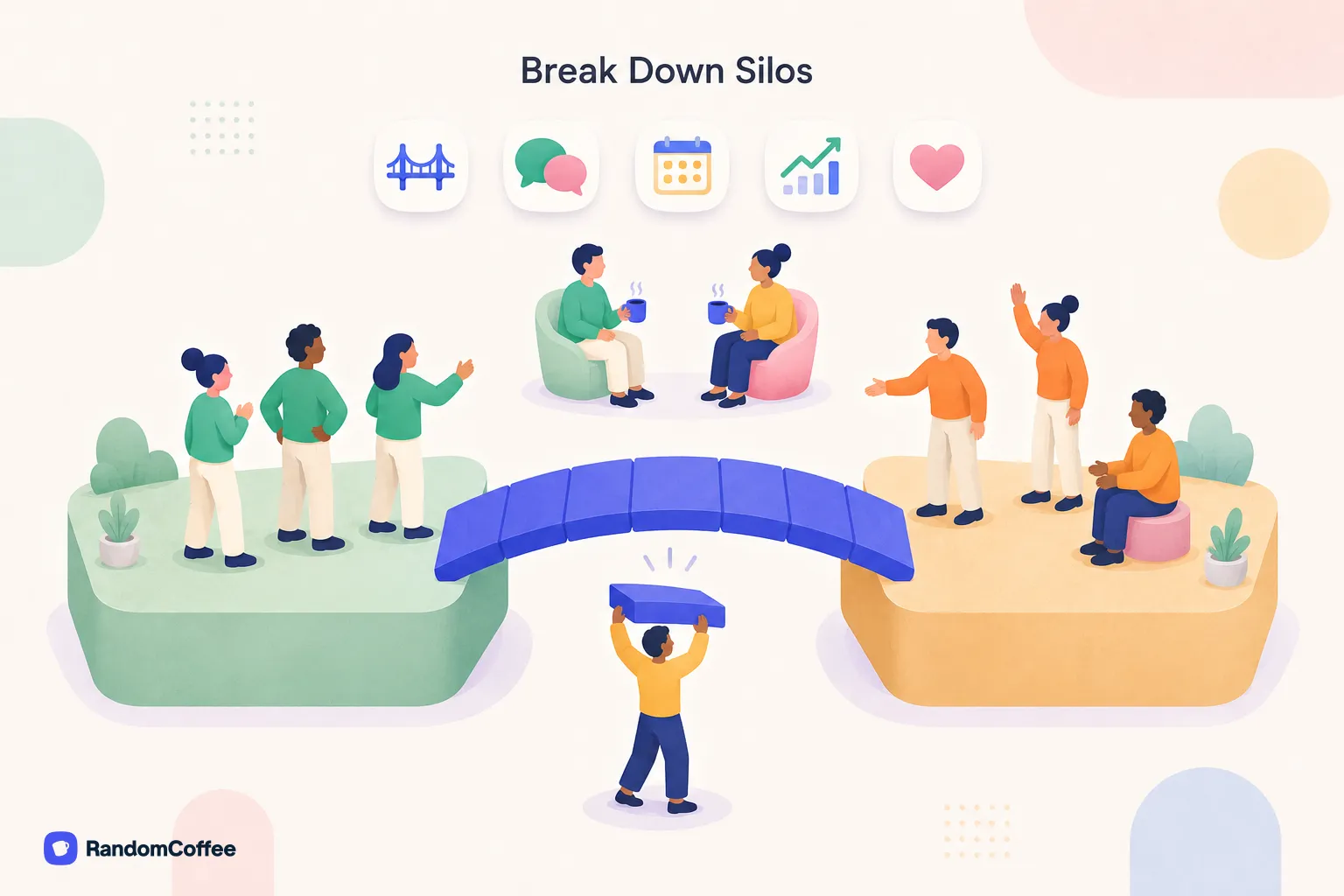
An effective program has four components:
1. Algorithmic matching across boundaries
The core mechanism is simple: pair employees from different departments for a brief, informal conversation on a regular cadence. The matching should be intentional, not random. The algorithm should consider department, seniority level, location, and previous connections to maximize the diversity of each pairing.
This is what separates a connection program from "just grab coffee with someone." Left to their own devices, people connect with people who look, think, and work like them. An algorithm ensures that a junior marketer in Paris meets a senior engineer in New York, a connection that creates organizational value precisely because it would never happen naturally.
2. A regular cadence that builds habits
Weekly or biweekly matches work best. Monthly is too infrequent to build momentum. The conversation should be short (15 to 20 minutes) and low-pressure. No agenda required. No deliverables expected. The goal is a human connection, not a work output.
3. Low friction, high integration
The program should live where employees already work: Slack, Microsoft Teams, or Google Calendar. If participating requires downloading an app, logging into a new platform, or manually scheduling a meeting, adoption will crater. The best programs send an automated match notification, propose available time slots, and confirm the meeting, all without the employee lifting a finger.
4. Visible metrics for HR and leadership
You need to prove this works. Track:
- Network density: average number of cross-departmental connections per employee
- Participation rate: percentage of enrolled employees who actually have their conversations
- Reach: percentage of departments connected (are any still isolated?)
- Qualitative feedback: post-conversation micro-surveys ("Did this conversation surface something useful?")
- Correlation with retention and engagement: over time, compare participating employees' eNPS and turnover against non-participants
What Happens When You Get It Right
The most immediate effect is speed. When a product manager already knows someone in legal, a contract question gets answered in a DM instead of a two-week email chain. When a sales rep has a personal connection in engineering, a customer request gets triaged in hours, not days.
The longer-term effect is culture. Employees who know people across the organization develop a broader sense of identity. They stop thinking of themselves as "someone on the finance team" and start thinking of themselves as "someone at this company." That shift, from team identity to organizational identity, is the foundation of belonging.
And the compound effect is powerful: every connection creates the possibility for more connections. Employee A introduces Employee B to Employee C. Networks build on networks. One coffee chat per week, across a 500-person company for 6 months, creates thousands of new cross-departmental relationships that did not exist before.
How RandomCoffee Makes This Effortless
RandomCoffee was built specifically for this use case. The platform handles every part of the process:
- Smart matching that pairs employees across departments, locations, and seniority levels based on configurable rules
- Automated scheduling through Slack, Teams, or calendar integration
- Conversation nudges with optional icebreaker questions or themes
- Analytics dashboard showing network density, participation trends, and departmental connectivity maps
- Onboarding integration: new hires are automatically enrolled and matched with experienced employees from different teams, accelerating their time-to-belonging
The result: HR teams launch a cross-departmental connection program in days, not months, and scale it across the entire organization without adding administrative overhead.
The Bottom Line
Silos are not inevitable. They are the default state of organizations that leave connection to chance. Every company starts connected (when you are 20 people, everyone knows everyone) and slowly fragments as it grows, unless it actively invests in rebuilding the bridges that scale breaks.
A cross-departmental connection program is the simplest, most scalable way to do that. It does not require a reorg, a culture transformation initiative, or a six-figure consulting engagement. It requires giving people a reason and a mechanism to meet someone new, every week.
That is it. That is the whole strategy. The relationships do the rest.
See how RandomCoffee breaks down silos at scale, one connection at a time →
Frequently Asked Questions
How do you measure whether silos are actually breaking down?
Track cross-departmental interaction frequency (messages, meetings, coffee chats), time to resolve cross-functional requests, and internal mobility rates. Behavioral data is more reliable than surveys. If people are collaborating across boundaries more often and resolving cross-team issues faster, silos are breaking down.
What if employees resist being matched with strangers?
Resistance usually comes from uncertainty, not unwillingness. Make the first step low-pressure: a 15-minute virtual coffee chat with an optional icebreaker question. Most participants report that the conversation was easier and more enjoyable than expected. After the first match, opt-out rates typically drop below 10%.
Should managers participate in the program?
Absolutely. When managers participate, it signals that cross-departmental connection is valued, not just tolerated. It also gives managers visibility into other parts of the organization, making them better leaders. The most effective programs include skip-level matches between senior leaders and individual contributors from other departments.