Why Mentoring Programs Matter: The Strategic Advantage Most Companies Miss


Most companies say they believe in developing their people. Very few actually build the systems to do it. They invest in LMS platforms, mandatory training, and annual development plans that sit in a shared drive collecting dust. Meanwhile, the single most effective development tool in human history, mentoring, gets treated as an informal afterthought.
That's a costly mistake. Organizations with structured mentoring programs see 50% higher retention, faster time-to-productivity for new hires, and measurably stronger leadership pipelines. And yet, only 37% of professionals report having a mentor. The gap between knowing mentoring works and actually building a program is where most companies stall.
Here's why closing that gap should be your next strategic priority.
The Data Behind Mentoring
The research is consistent across industries, company sizes, and geographies. A meta-analysis of 112 studies found that mentoring delivers significant behavioral, attitudinal, and career benefits for both mentees and mentors. These aren't marginal improvements. They're structural advantages that compound over time.
Yet many leaders still treat mentoring as something that "just happens" between well-connected employees. It doesn't. Without structure, mentoring follows existing power dynamics: it reaches people who already have access and skips those who need it most.
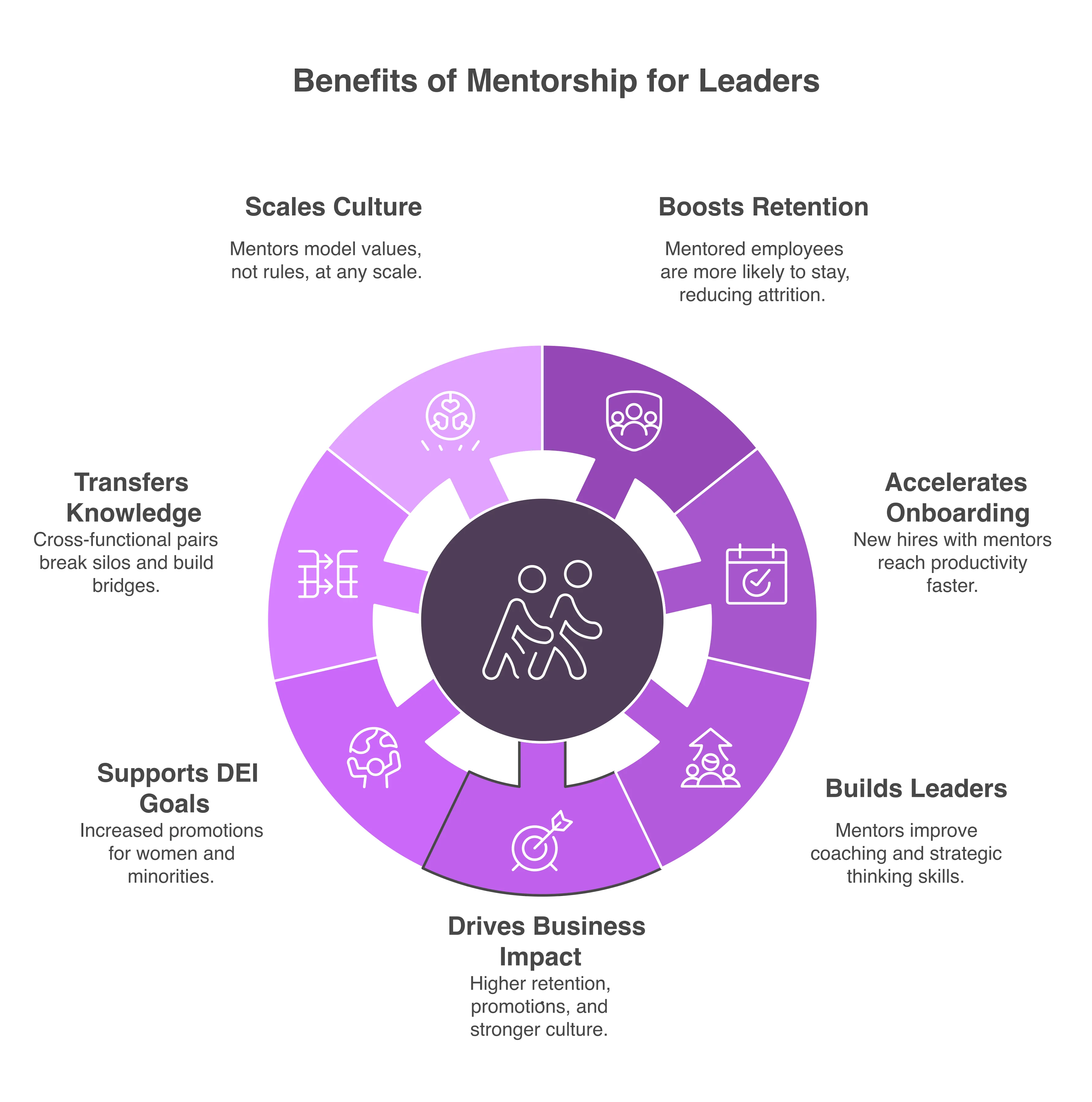
7 Reasons Mentoring Programs Are Worth the Investment
1. Retention That Actually Sticks
Replacing an employee costs between 50% and 200% of their annual salary. Mentoring directly attacks the root causes of attrition: lack of growth, feeling invisible, and weak organizational connection. Employees who are paired with a mentor are twice as likely to stay compared to those who aren't. That's not a marginal lift. That's cutting your attrition risk in half.
The mechanism is straightforward. Mentoring gives employees someone who is invested in their success, someone who helps them see a future inside the company. Without that, every LinkedIn recruiter message looks like a better option.
2. Faster, Deeper Onboarding
New hires with a mentor reach full productivity 3 to 6 months faster than those without one. A mentor provides the unwritten context that no onboarding deck covers: how decisions really get made, which stakeholders matter, what the cultural norms are, and how to navigate ambiguity.
Onboarding programs that pair new hires with experienced mentors don't just accelerate learning. They build the relational infrastructure that turns a new employee into a connected, contributing team member.
3. A Leadership Pipeline That Builds Itself
Mentoring is leadership training in practice, not in theory. When a senior employee mentors a junior colleague, both develop. The mentor strengthens coaching, communication, and strategic thinking skills. The mentee gains exposure to leadership mindsets and organizational perspective they wouldn't access otherwise.
Companies like Google, Intel, and General Electric have long used mentoring programs to identify and develop high-potential employees. The pattern is consistent: organizations that invest in mentoring develop leaders faster and from more diverse talent pools.
4. Cross-Functional Knowledge Transfer
Silos are the default state of every growing organization. Mentoring breaks them. When you pair a product manager with a senior engineer, or a marketing lead with an operations director, knowledge flows across boundaries that org charts would otherwise seal shut.
This isn't just about individual development. It's about organizational intelligence. Every mentoring pair creates a bridge between two teams, two perspectives, two knowledge bases. Multiply that across dozens or hundreds of pairs, and you've built a knowledge network that no wiki or documentation system can replicate.
5. Diversity, Equity, and Inclusion That Goes Beyond Hiring
Hiring diverse talent is step one. Retaining and advancing them is the real challenge. Mentoring is one of the most effective tools for closing the gap between diverse representation at entry level and diverse leadership at the top.
Employees from underrepresented groups who have a mentor are significantly more likely to be promoted, to stay, and to report a strong sense of belonging. A mentor provides sponsorship, not just advice. They advocate for their mentee in rooms the mentee isn't in yet. That's the difference between a well-intentioned DEI program and one that produces results.
6. Employee Engagement That Comes From Within
Engagement surveys measure symptoms. Mentoring addresses causes. When employees have someone actively invested in their growth, their relationship to work shifts. They're not just executing tasks. They're building a career, learning a craft, and contributing to something larger.
And the effect is bidirectional. 65% of mentors report that the mentoring relationship improved their own leadership skills and job satisfaction. Mentoring isn't a one-way transfer. It's a relationship that elevates both participants.
7. Culture That Scales
Culture is what people do when nobody's watching. Mentoring programs embed cultural norms through relationships, not rules. A mentor doesn't just explain what the company values. They model it. They demonstrate how to give feedback, how to handle conflict, how to prioritize, how to lead. This is how culture transmits across generations of employees, even as the company grows from 100 to 1,000 to 10,000.
Without mentoring, culture dilutes with every wave of hiring. With it, every new cohort is connected to someone who carries the institutional memory, the behavioral standards, and the relational warmth that make a company a place people want to stay.
Why Most Mentoring Programs Fail (And How to Fix It)
If mentoring is so powerful, why do so many programs underperform? Three common failure modes:
Bad Matching
Randomly assigning mentors to mentees based on availability is a recipe for awkward, low-value conversations that both parties quietly abandon. Effective matching considers goals, skills, experience gaps, personality fit, and cross-functional exposure. Programs that let participants have input in their match consistently outperform those that assign pairs top-down.
No Structure, No Accountability
"Just grab coffee sometime" isn't a program. It's a suggestion. Successful mentoring programs provide conversation guides, meeting cadences, milestone check-ins, and measurable goals. Structure doesn't kill authenticity. It creates the conditions for it.
Manual Administration That Doesn't Scale
An HR team can manually match 20 pairs. They cannot manually match 200. And they certainly can't track engagement, measure outcomes, and iterate on matching quality across the organization without technology. This is where most companies hit a wall: the program works at small scale and collapses when they try to grow it.
Tools like RandomCoffee solve exactly this problem. Algorithmic matching based on goals, skills, and organizational context. Automated scheduling that removes the friction. Analytics that show which pairs are meeting, which conversations are producing results, and where the program needs adjustment. Mentoring that scales without losing the human element.
How to Build a Mentoring Program That Works
Step 1: Define What You're Solving For
Mentoring can serve many goals: onboarding acceleration, leadership development, diversity advancement, knowledge transfer, or cultural integration. Pick your primary objective and design around it. A program trying to do everything will accomplish nothing.
Step 2: Match With Intent, Not Convenience
The quality of the match determines the quality of the relationship. Use data: skills the mentee wants to develop, experience the mentor brings, organizational distance (cross-team pairs learn more), and shared interests that create rapport. Technology makes this scalable; intuition alone does not.
Step 3: Provide Structure Without Micromanaging
Give pairs a framework: suggested meeting frequency (biweekly works best), conversation starters for the first few sessions, and quarterly check-ins to assess progress. Then get out of the way. The best mentoring relationships develop their own rhythm once the initial friction is removed.
Step 4: Measure and Iterate
Track participation rates, meeting frequency, mentee satisfaction, and business outcomes (retention, promotion rates, internal mobility). Use this data to improve matching, adjust program design, and demonstrate ROI to leadership. What gets measured gets funded.
Mentoring in a Hybrid World
The rise of remote and hybrid work hasn't reduced the need for mentoring. It's amplified it. Remote employees are more likely to feel disconnected, more likely to miss informal learning opportunities, and more likely to leave within 18 months. Mentoring provides the intentional relationship structure that replaces the hallway conversations and lunch interactions that used to happen organically.
Virtual coffee chats and digital mentoring pairs work. The research shows that well-structured virtual mentoring relationships deliver outcomes comparable to in-person ones. The key word is well-structured. Telling remote employees to "find a mentor" is as effective as telling them to "build a network." Without a system, it won't happen for most people.
The Bottom Line
Mentoring isn't a nice-to-have benefit you add when the budget allows. It's a strategic investment that directly impacts retention, development, diversity, and culture. The companies that build scalable mentoring programs will develop leaders faster, keep their best people longer, and build cultures that attract talent instead of losing it.
The good news: you don't need to figure this out from scratch. The playbook exists. The technology exists. The only question is whether you'll treat mentoring as a system worth building or continue hoping it happens on its own.
It won't. Build the system.
Frequently Asked Questions
What's the difference between mentoring and coaching?
Coaching is typically short-term and task-focused: improving a specific skill or navigating a specific challenge. Mentoring is a longer-term relationship focused on holistic professional development, career navigation, and organizational acumen. Both are valuable; they serve different purposes.
How long should a mentoring pairing last?
Most effective mentoring cycles run 6 to 12 months. Shorter than 6 months rarely allows enough depth. Longer than 12 months risks stagnation. After a cycle, pairs can choose to continue, rotate to new matches, or transition to an informal relationship.
Can mentoring work in fully remote organizations?
Yes. Research shows virtual mentoring relationships produce comparable outcomes to in-person ones when they have structure: regular meeting cadences, conversation frameworks, and platform support. The key is removing friction from scheduling and providing enough guidance that pairs don't stall after the first conversation.
How do you measure mentoring program ROI?
Track four categories: participation (are pairs meeting regularly?), satisfaction (do mentees and mentors find it valuable?), development (are mentees building targeted skills?), and business outcomes (retention rates, promotion rates, internal mobility for mentored vs. non-mentored employees). The business outcome data is what gets executive buy-in for continued investment.