How to Maintain Company Culture During Rapid Growth (Without Losing What Made You Great)


Growth is what every company works toward. More customers, more revenue, more headcount. But somewhere between 50 and 500 employees, something shifts. The things that made the company special start to fade. New hires don't absorb the culture the way early employees did. Communication gets noisier. Silos form. Decision-making slows down. And one day, a long-tenured employee says the thing everyone has been thinking: "This place doesn't feel the same anymore."
That's not a failure of values. It's a failure of systems. Culture doesn't die because people stop caring. It dies because the informal mechanisms that sustained it (hallway conversations, small-team lunches, founders knowing everyone's name) collapse under the weight of scale. The companies that maintain strong culture during rapid growth are the ones that replace those informal mechanisms with intentional ones.
Here's how they do it.
Why Culture Breaks During Rapid Growth
Before you can fix the problem, you need to understand why it happens. Culture erosion during scaling isn't random. It follows predictable patterns.
The Dunbar Problem
Anthropologist Robin Dunbar found that humans can maintain about 150 stable relationships. When a company is under that threshold, culture is ambient. Everyone knows everyone. Norms are transmitted through observation. Once you cross it, people start interacting only with their immediate team. The shared experience that defined your culture fragments into team-level subcultures, some aligned with your values, some not.
The Onboarding Bottleneck
When you're hiring 10 people a month, each new hire gets personally onboarded by someone who deeply understands the culture. When you're hiring 50 a month, onboarding becomes a conveyor belt: here's your laptop, here's your Slack workspace, here's a 90-minute culture presentation. The information transfers. The feeling doesn't.
The Middle Management Gap
Rapid growth creates a leadership vacuum. Individual contributors get promoted into management roles before they've had time to internalize the culture deeply enough to transmit it. These new managers set the tone for their teams, and if they default to their previous company's norms instead of yours, culture drifts from the inside out.
The Communication Breakdown
At 30 employees, you can communicate important decisions in a single all-hands meeting. At 300, you need layers: team leads relay messages to managers, who relay them to their direct reports. Each relay introduces distortion. By the time information reaches the front line, context is lost and meaning has shifted.
The Framework: Four Pillars of Scalable Culture
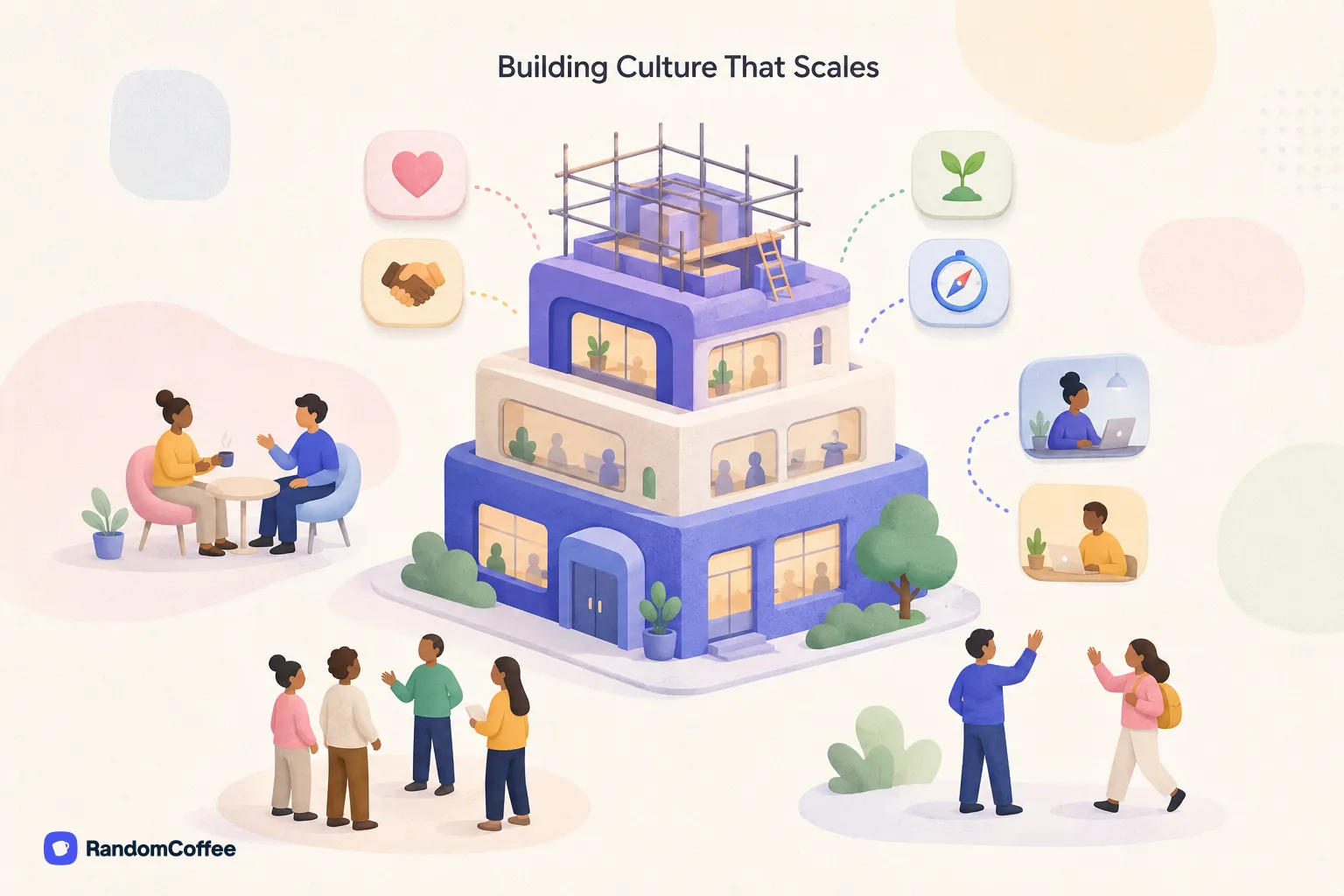
Companies that sustain culture through growth don't rely on a single tactic. They build systems across four pillars that reinforce each other.
Pillar 1: Codify What Matters
Culture that lives only in the heads of founders doesn't scale. The first step is making the implicit explicit.
This doesn't mean writing a values poster and hanging it in the lobby. It means documenting the specific behaviors that demonstrate your values. "We value transparency" is a platitude. "We share project status updates weekly, including what's going wrong" is a behavior. "We value collaboration" is a poster. "We default to cross-functional working groups for any initiative that touches more than one team" is a practice.
Netflix famously documented their culture in a 125-slide deck that became one of the most important documents in Silicon Valley history. You don't need 125 slides, but you need something concrete enough that a new hire in month two can understand not just what you value, but what that looks like in daily work.
Pillar 2: Hire for Culture Add, Not Culture Fit
The concept of "culture fit" has a dark side: it can become a filter for similarity rather than alignment. The best hyper-growth companies have shifted to "culture add," hiring people who share the company's core values but bring new perspectives, backgrounds, and approaches.
This requires structured interviewing. Every candidate should face questions designed to assess value alignment, not personality compatibility. "Tell me about a time you disagreed with a decision and what you did" reveals more about cultural alignment than "would you want to grab a beer with this person?"
The data supports this approach. Companies with diverse teams outperform homogeneous ones by 36% in profitability (McKinsey, 2023). Culture add builds a stronger company than culture fit.
Pillar 3: Build Connection Infrastructure
This is where most scaling companies fail. They assume connections will happen organically. They won't.
When you go from 80 to 400 employees in 18 months, most people will never meet colleagues outside their immediate team. The cross-pollination of ideas, the shared sense of identity, the feeling of belonging to something larger than your team: all of it depends on people actually knowing each other.
Structured connection programs solve this at scale. Virtual coffee chats, mentoring pairings, cross-functional introductions, onboarding buddy programs: these are the systems that replace the organic interactions lost to growth. They don't feel forced when they're well-designed. They feel like the company investing in its people.
Tools like RandomCoffee automate this: algorithmically matching employees across teams, seniority levels, and locations so that connection doesn't depend on proximity or personal initiative. When a product designer in Paris has a 30-minute conversation with an engineer in New York, culture crosses borders that org charts can't.
Pillar 4: Measure and Iterate
You can't manage what you don't measure. Culture is often treated as intangible, but its indicators are very measurable: employee engagement scores, cross-team collaboration frequency, onboarding satisfaction, voluntary attrition rates, internal mobility, and participation in company-wide initiatives.
Set baselines before the growth phase. Track them quarterly. When engagement drops in a specific team or cohort, investigate. The data will tell you where culture is holding and where it's cracking, usually before people start leaving.
Tactical Playbook: 8 Strategies That Actually Work
1. Redesign Onboarding for Culture Transmission
Your onboarding program is the single highest-leverage point for culture during growth. Every new hire is a potential culture carrier or a culture diluter. The difference is what happens in their first 90 days.
Go beyond process orientation. Pair every new hire with a culture buddy (not their manager, not their team lead) who has been at the company for at least a year. Give them structured conversation prompts for the first month: "What surprised you about how we make decisions?" "What feels different here compared to your last company?" These conversations surface cultural nuances that no documentation can capture.
2. Create Cross-Team Rituals
Rituals are how culture transmits without top-down enforcement. Weekly show-and-tells where teams demo what they're working on. Monthly cross-functional lunches. Quarterly hackathons. Annual off-sites. Each ritual serves a different purpose, but all of them create shared experiences across team boundaries.
The key is consistency. A quarterly event that happens three times and then gets "too hard to organize" does more damage than having no event at all. Start with rituals you can sustain at 10x your current size.
3. Invest in Middle Managers
Your managers are your culture's transmission layer. If they don't understand and embody the culture, it won't reach their teams, regardless of what the CEO says at all-hands.
Invest heavily in new manager training. Not just operational training (how to run a 1:1, how to do performance reviews) but cultural training: what does it mean to lead at this company? How do we handle disagreement? What does accountability look like here? Pair new managers with senior leaders through a mentoring program so they absorb leadership culture through relationship, not just instruction.
4. Protect Informal Communication Channels
As companies grow, the temptation is to formalize everything: more Jira tickets, more approval chains, more structured meetings. Some of this is necessary. But protect spaces for unstructured interaction.
Keep Slack channels for non-work topics (hobbies, pets, recommendations). Maintain open office hours where anyone can talk to leadership. Create physical or virtual spaces where people from different teams can collide by chance, or by design.
5. Distribute Cultural Leadership
Culture can't be the CEO's responsibility alone. At scale, you need cultural ambassadors at every level: people who naturally embody and advocate for the company's values and who can influence their peers.
Identify these people. Give them a role (formal or informal) in shaping culture initiatives. Include them in decisions about company events, communication tone, and new employee integration. Culture is too important to centralize and too fragile to delegate entirely to HR.
6. Maintain Transparency as a Default
One of the first casualties of growth is transparency. Information that used to flow freely gets compartmentalized. Leadership starts making decisions in smaller rooms. Employees feel the shift even if they can't articulate it.
Fight this actively. Share board decks (redacted where necessary). Publish monthly business updates with real numbers. Hold quarterly AMAs where no question is off-limits. Transparency builds trust, and trust is the substrate on which culture grows.
7. Adapt, Don't Preserve
Here's the counterintuitive truth: trying to preserve your culture exactly as it was at 20 employees will destroy it at 200. Culture needs to evolve. The core values should remain, but their expression will change.
"Move fast and break things" works at a 10-person startup. At a 500-person company, it needs to become "move fast with guardrails." The spirit is the same (bias toward action, comfort with imperfection), but the practice adapts to the stakes. Companies that cling to startup-era cultural expressions while operating at enterprise scale create cognitive dissonance that employees can feel.
8. Make Belonging a KPI
Culture is ultimately about whether people feel they belong. Not just "I work here" but "I'm part of this." During rapid growth, belonging is the first thing new hires struggle with and the last thing leadership measures.
Add belonging questions to your engagement surveys. Track how quickly new hires build cross-team relationships. Measure participation in voluntary company initiatives. When belonging scores are high, retention follows, engagement follows, and performance follows.
The Role of Technology in Scaling Culture
Technology alone won't save your culture. But without it, culture can't scale. Here's the math: if you have 500 employees and want each person to have a meaningful interaction with someone outside their team once a month, that's 250 unique pairings per month. No HR team can manage that manually. No spreadsheet survives past month two.
Platforms designed for employee connection, like RandomCoffee, handle the logistics that make culture programs scalable: matching people based on goals, teams, locations, and interests; automating scheduling so participation requires zero friction; tracking engagement so you can measure what's working and iterate on what isn't.
This is especially critical for hybrid and remote organizations. When half your team is in the office and half is distributed across time zones, the connection gap widens faster. Technology closes it by making cross-location, cross-team interaction a default, not an exception.
What the Best Companies Do Differently
The companies that maintain culture through hyper-growth share three traits:
They treat culture as a system, not a sentiment. They don't rely on good vibes and hope. They build programs, measure outcomes, and iterate. Culture is an operational priority with dedicated resources, not an afterthought squeezed into quarterly all-hands meetings.
They invest before the pain. They don't wait until turnover spikes to start thinking about culture. They build connection infrastructure, manager training, and onboarding rituals during the calm before the growth storm. Proactive investment costs a fraction of reactive damage control.
They evolve deliberately. They know that culture at 500 employees won't look like culture at 50. They hold the core values constant while adapting the practices, rituals, and communication styles to fit the company's current reality. Flexibility isn't weakness; it's maturity.
The Bottom Line
Rapid growth tests everything: your processes, your infrastructure, your people. But nothing is more fragile or more valuable than your culture. The companies that scale successfully don't just grow their headcount. They grow their capacity for connection, belonging, and shared purpose.
Culture doesn't maintain itself. It's maintained by systems that make the right behaviors easy, by leaders who model the values every day, and by infrastructure that ensures every employee, whether they joined yesterday or five years ago, feels connected to something larger than their team.
Build those systems now. Your future 500-person company will thank your current 50-person company for it.
Frequently Asked Questions
At what company size does culture start to break down?
Most companies feel the first cracks around 100-150 employees, which aligns with Dunbar's number (the cognitive limit on stable social relationships). However, the groundwork for scalable culture needs to start much earlier, ideally when you cross 50 employees and can still course-correct easily.
How do you maintain culture in a remote-first company?
Remote companies need to be even more intentional about culture. Since there are no hallway conversations or lunch-table collisions, every meaningful interaction must be designed. Structured virtual coffee chats, regular video all-hands, asynchronous culture-sharing channels, and quarterly in-person gatherings form the foundation. The key is replacing spontaneity with intentionality.
Should we hire a Head of Culture?
A dedicated culture leader can be valuable during hyper-growth, but only if the role has real authority and budget. A Head of Culture who writes blog posts but can't influence hiring practices, onboarding design, or management training won't move the needle. Culture leadership works best when it sits at the intersection of HR, internal communications, and executive strategy.
How do you measure culture health during scaling?
Track five metrics quarterly: engagement scores (overall and by tenure cohort), voluntary attrition rate, new hire 90-day satisfaction, cross-team interaction frequency, and belonging/inclusion scores. Compare these across growth phases to identify where culture is holding and where it's eroding.
Can you rebuild culture after it's been lost?
Yes, but it's significantly harder and more expensive than maintaining it proactively. Rebuilding requires acknowledging the gap publicly, investing in structured connection and communication programs, retraining managers, and often making difficult decisions about leaders who don't align with the culture you're trying to restore. Prevention is always cheaper than repair.