Meaning at work: how informal connections bring purpose back to everyday work


63% of French workers feel their job lacks meaning. This figure, from a study reported by Parlons RH, does not reflect a generational whim. It reveals a deep gap between what employees experience every day and what they need to fully commit.
The topic is not new, but it has taken on unprecedented scale. Between silent brownout, the rise of hybrid work and repeated reorganizations, the search for meaning has become a strategic issue for HR teams. What if the answer did not lie in yet another off-site or internal communication campaign, but in something much simpler: informal connections between colleagues?
Why meaning at work is eroding
Meaning at work rests on three complementary dimensions. An emotional dimension: feeling more positive than negative emotions in your day-to-day work. A cognitive dimension: understanding the purpose of your tasks and seeing the concrete impact of your actions. An aspirational dimension: feeling that you contribute to a collective project you genuinely believe in.
When one of these dimensions collapses, disengagement sets in. Not abruptly, but gradually: this is brownout, a loss of meaning distinct from burnout (overload) and boreout (boredom). Employees can have a normal workload and still no longer understand why they do what they do.
The causes are many: top-down management that leaves no room for feedback, company values that are displayed but not lived, or simply a lack of prospects. But one factor is often underestimated: relational isolation.
Social connection, the invisible foundation of meaning
75% of working people would reportedly be ready to change employers for a better work-life balance. Behind this figure lies something engagement surveys capture poorly: employees do not just leave a job, they leave an environment where they feel invisible.
According to a 2025 KPMG study, 45% of employees say they feel isolated at work. In hybrid organizations, the figure climbs even higher. Interactions are limited to scheduled meetings, transactional Slack messages and weekly team check-ins. The spontaneous moments, when you find out what the colleague on the third floor or the department across the hall actually does, have simply disappeared.
Yet it is precisely in these informal interactions that meaning is built. Not in a strategy document, but in a conversation over coffee. When a developer understands how their work affects the sales team's day-to-day. When an HR professional discovers the real challenges on the production floor. When a new hire realizes they are part of something bigger than their job description.
How informal connections restore meaning
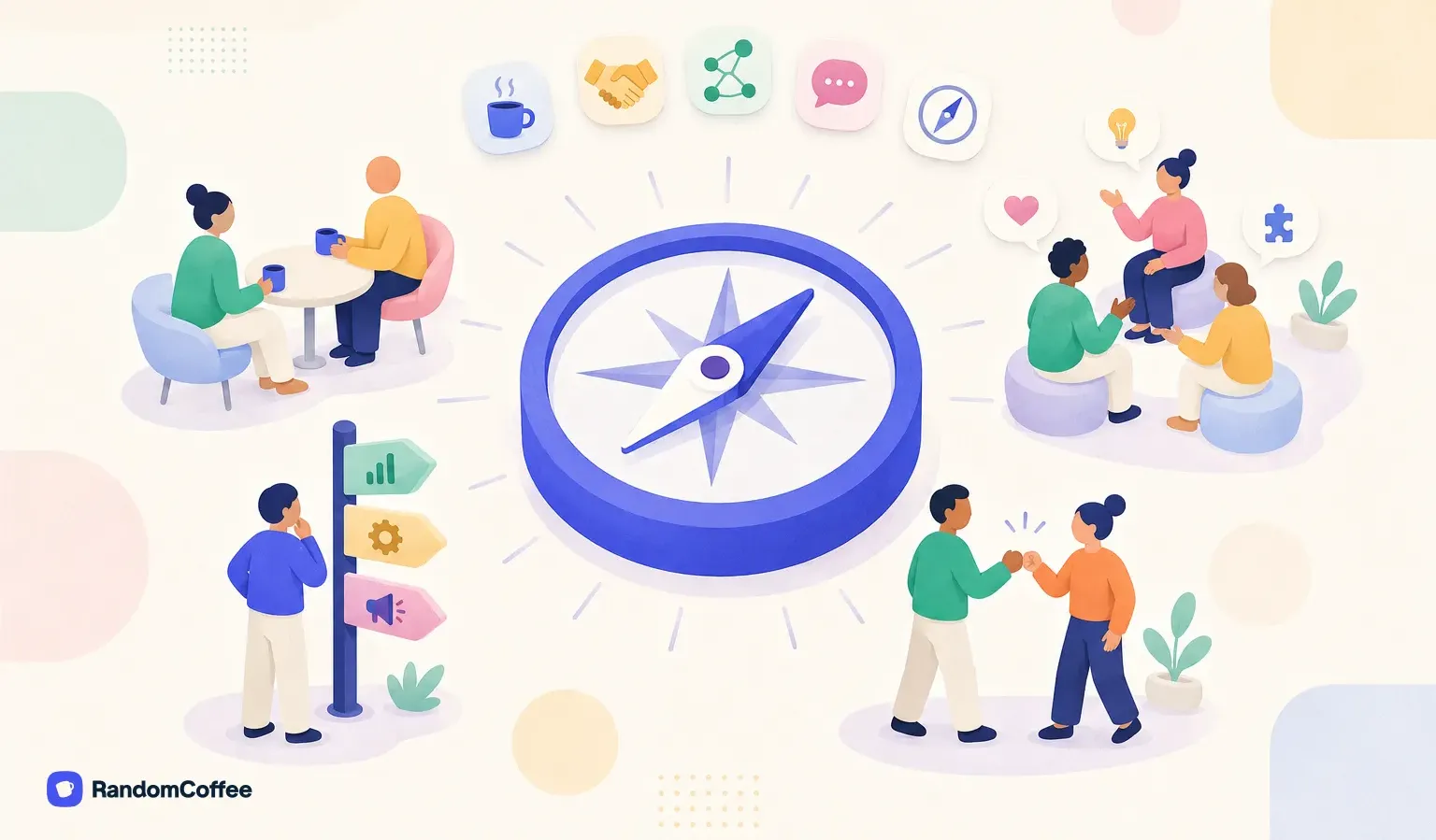
Research in organizational behavior is clear: weak ties (occasional connections between people who do not work together day to day) are powerful drivers of trust, innovation and resilience. A brief informal conversation can normalize emotions, spark new ideas and remind employees that they are not alone.
1. Make the impact of work visible
When you talk regularly with colleagues from other teams, you naturally discover how your work fits into the value chain. It is no longer your manager telling you "your work matters" in an annual review. It is a colleague from customer support telling you how your latest feature solved a real problem.
This direct visibility on the impact of one's contributions is one of the most powerful levers of meaning at work.
2. Build a sense of belonging beyond the team
Belonging is not limited to the direct team. BetterUp's research shows that employees with at least 5 cross-team connections report a 45% higher belonging score. Professional identity shifts: from "I'm part of the marketing team" to "I'm part of this organization".
This is what Welcome to the Jungle, the French careers and workplace media, calls belonging: that certain something that makes you want to put down roots in a company and picture your future there. Informal social connection is what holds it together.
3. Give meaning to periods of change
Reorganizations, new strategies and digital transformations naturally create uncertainty. According to Gartner, more than 70% of transformation initiatives fail, mainly because of change fatigue and employee disengagement.
Informal connections act as anchor points during these transitions. They let employees share their questions, understand other teams' perspectives and build meaning together, rather than receiving it passively through an email from leadership.
4. Fight hybrid isolation
Hybrid work is not the enemy of meaning. Unstructured hybrid work is. When interactions are limited to formal meetings, employees lose the emotional dimension of their relationship with work. Informal moments between teams are the necessary counterweight: they recreate the spontaneity the office once offered naturally.
Setting up connection rituals: a practical guide
Here are the key principles to make these rituals last:
- Regularity over intensity. A 20-minute coffee every week is worth more than a quarterly team-building event. Meaning is built through repetition, not one-off events.
- Diverse encounters. The goal is to connect employees from different departments, levels and sites. Meaning emerges from a diversity of perspectives.
- Easy access. If taking part takes 10 clicks and 3 approvals, nobody will do it. The tool must fit natively into everyday work (Slack, Teams, Google Calendar).
- Measured effects. Track the participation rate, eNPS, retention and qualitative feedback. Meaning is subjective, but its effects are measurable.
RandomCoffee automates this mechanism: a matching algorithm connects each employee with a colleague they would probably never have met otherwise. Meetings are scheduled automatically, reminders are sent, and HR teams have a dashboard to track the social vitality of the organization.
What companies that have done it are seeing
Employees who take part in informal connection programs consistently report a better understanding of the company's strategy, a stronger sense of purpose and a stronger intent to stay. Not because someone explained the vision to them, but because they experienced it through conversations with their colleagues.
Meaning cannot be decreed, it has to be lived
Giving meaning to work is not about writing a more inspiring purpose statement or holding an annual values off-site. It is about creating the conditions for every employee, day after day, to understand the impact of their work, feel connected to others and contribute to something bigger than themselves.
Informal connections are the most natural, most economical and most effective way to get there. There is no need for an exceptional budget or a massive culture transformation. You just need to let the right conversations happen, regularly, between the right people.
Meaning at work is not an unreachable holy grail. It is a coffee shared with the right person, at the right time.
See how RandomCoffee helps your teams find meaning again, one connection at a time →
Frequently asked questions
Do informal connections also work for fully remote teams?
Yes, and that is where they are needed most. Fully remote teams that set up structured connection rituals (weekly virtual coffees, for example) often show better belonging scores than office-based teams without a dedicated program.
How do you convince leadership to invest in this kind of program?
Show them the data. BetterUp estimates that a lack of belonging costs large companies more than $52 million a year in turnover and lost productivity. An informal connection program is a minimal investment for a measurable impact on retention and engagement.
How long does it take to see the first results?
The first signals (participation, positive feedback) appear within the first 2 to 3 weeks. The effects on HR indicators (eNPS, retention) can be measured from 3 months.