The Manager's Guide to Coffee Chats That Build Trust (Not Just Small Talk)


Most managers know they should connect with their teams more. Fewer know how. The default is a calendar invite labeled "Coffee Chat" or "Quick Sync" that turns into either 20 minutes of weather talk or a disguised status update. Neither builds trust. Both waste time.
The data makes the stakes clear: Gallup found that 80% of employees who received meaningful feedback in the past week are fully engaged, regardless of how many days they work from the office. That is four times the engagement lift of having the "right" number of in-office days. Yet only 16% of employees say their last conversation with their manager was extremely meaningful.
The gap between "having conversations" and "having conversations that matter" is where most managers get stuck. This guide closes that gap.
Why Coffee Chats Are a Manager's Most Underused Tool
One-on-ones are supposed to be the manager's secret weapon. In practice, they become another box to check: a 30-minute slot where the manager asks "How's everything going?", the employee says "Fine," and both return to their screens feeling like they accomplished nothing.
Coffee chats are different. When done well, they remove the performance pressure of a formal 1:1 and create space for the conversations that actually build trust: the ones where an employee shares what is really on their mind, where a manager learns something they would never hear in a team meeting, and where both sides leave feeling more connected, not just more informed.
Google's Project Aristotle research confirmed what the best managers already knew: psychological safety is the single most important factor in team effectiveness. And psychological safety is not built in all-hands meetings or through open-door policies. It is built in small, repeated interactions where people feel safe to be honest.
A coffee chat is the simplest vehicle for those interactions.
The 5 Elements of a Trust-Building Coffee Chat
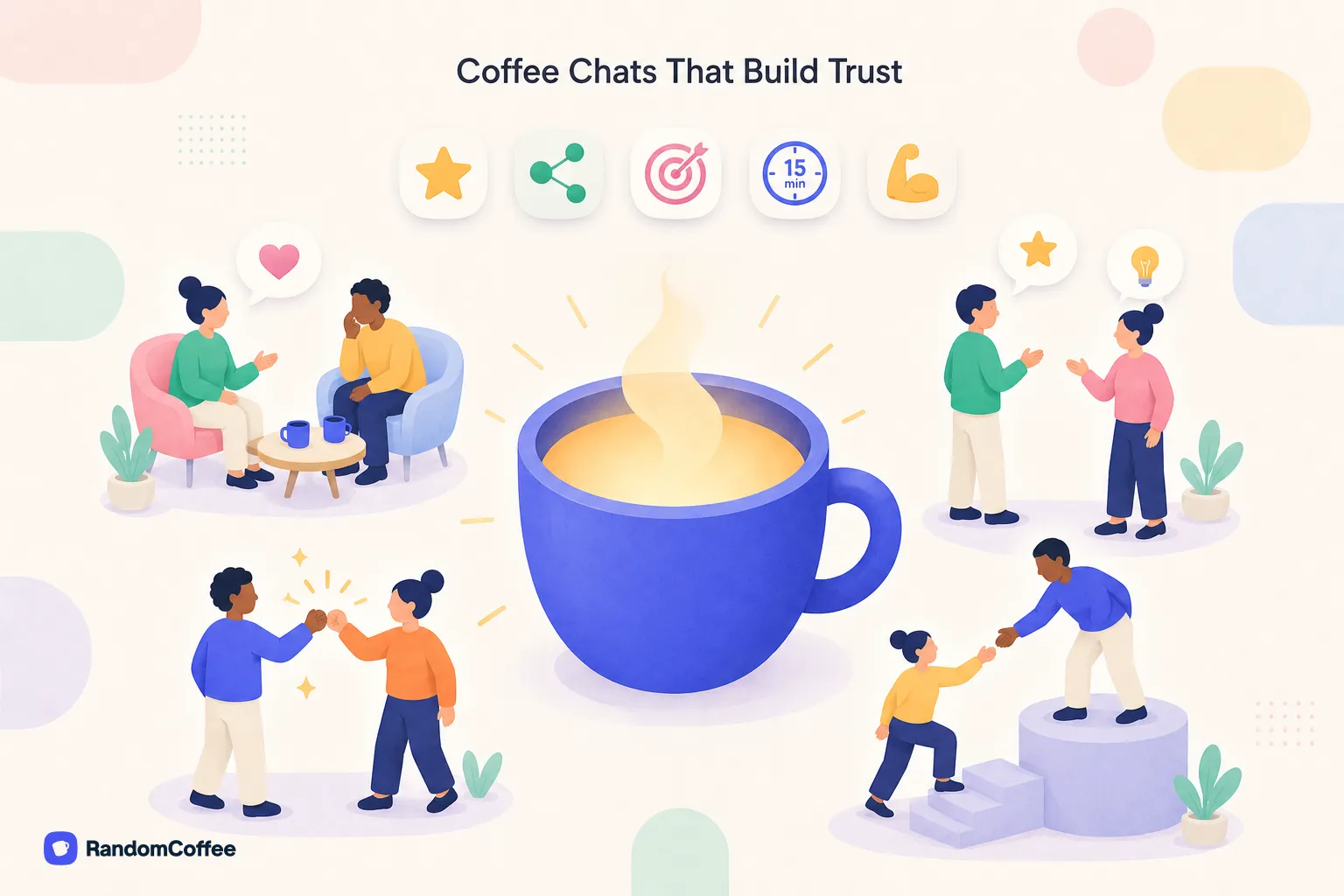
Gallup's research identified the five characteristics that separate meaningful manager conversations from forgettable ones. Adapt these to your coffee chats:
1. Start with recognition, not status updates
The most impactful thing a manager can do in the first two minutes is acknowledge something specific the employee did well recently. Not "great job this week" but "The way you handled the client escalation on Tuesday saved us the account. I noticed." Gallup and Workhuman found that only 23% of employees strongly agree they get the right amount of recognition. Those who do are four times more likely to be engaged.
Recognition first sets the tone. It signals: this conversation is about you as a person, not about your deliverables.
2. Ask about relationships, not just tasks
In hybrid and remote environments, collaboration and coworker relationships have become stronger predictors of retention than they were pre-pandemic. Ask questions like:
- "Who have you been working with lately that you find energizing?"
- "Is there anyone on another team you'd like to connect with?"
- "Do you feel like you have enough people to bounce ideas off?"
These questions do two things: they surface isolation early (before it becomes disengagement), and they give you actionable data. If an employee mentions they would love to connect with someone in product, you can make that introduction. That is trust in action. For a structured approach, virtual coffee chat programs can automate these cross-team connections.
3. Align on priorities, not just projects
Gallup data shows that clarity of work expectations has been declining, especially among younger employees. A coffee chat is the right moment to check: "Of everything on your plate right now, what feels most important? What feels least clear?" This is not a project status review. It is a priority calibration that ensures the employee is spending their energy on what matters most.
4. Keep it to 15-30 minutes, weekly
Gallup's research found that 15- to 30-minute conversations have a greater impact on engagement than 30- to 60-minute conversations, provided they happen regularly. Weekly beats biweekly. Biweekly beats monthly. Short and frequent beats long and rare, every time.
The reason is simple: trust compounds. Each brief, positive interaction adds a small deposit to the trust account. Skip three weeks and you are back to "How's everything going?" / "Fine."
5. Focus on strengths, not weaknesses
The one topic employees consistently rate as least meaningful in manager conversations is a discussion of their weaknesses. This does not mean you should avoid hard feedback. It means you should not lead with it. A coffee chat is not a performance review. It is a relationship builder. Discuss what they do well, how to do more of it, and where their strengths can be applied in new ways.
The Anti-Patterns: What Kills Trust in a Coffee Chat
Knowing what to do is half the battle. Knowing what not to do prevents the damage that undoes months of trust-building.
Turning it into a status update
"So, where are we on the Q3 roadmap?" instantly transforms a coffee chat into a check-in. The employee shifts from open mode to reporting mode. If you need a status update, send a Slack message. Protect the chat for human conversation.
Canceling repeatedly
Every cancellation sends a message: "You are not a priority." After two cancellations in a row, most employees stop expecting the meeting to happen. That is not just a scheduling issue. That is a trust rupture. If you absolutely must reschedule, do it proactively with a new time in the same message.
Making it one-directional
If you talk for 70% of the time, it is not a conversation. It is a monologue. The best coffee chats have the manager speaking less than 40% of the time. Ask open questions, then listen. The silence after a question is not awkward. It is where trust is formed.
Treating every employee the same way
Some team members need structured agendas. Others thrive in free-flowing conversations. Some want career coaching; others want to vent about a blocker. The best managers individualize their approach. Ask each employee: "What would make these coffee chats most useful for you?"
A Practical Framework: The 15-Minute Trust Builder
This is not a script. It is a rhythm. Some weeks the conversation will stay in "their world" for 12 minutes because they need to process a difficult situation. Other weeks you will spend most of the time on priorities because a big deadline is looming. The structure is a default, not a mandate.
The one non-negotiable: always close with a commitment you can keep. Trust is not built by having good conversations. It is built by doing what you said you would do after the conversation.
Scaling Coffee Chats Beyond Your Direct Reports
The most effective managers do not limit informal conversations to their own team. They also connect their team members with people across the organization: a skip-level conversation with a senior leader, a coffee roulette with someone from another department, or a mentoring pairing with someone two levels above.
Why does this matter? Because an employee who only knows their direct team is one reorganization away from feeling like a stranger. An employee with 5+ connections outside their team has a safety net of relationships that keeps them anchored through change.
RandomCoffee automates this at scale. The platform matches employees across teams, departments, and locations for regular informal conversations. Managers can enroll their teams, set matching rules (cross-department, cross-seniority, cross-location), and track participation without adding admin overhead to their week.
Measuring Whether Your Coffee Chats Are Working
You do not need a survey to know if your coffee chats are building trust. Watch for these behavioral signals:
- Employees bring problems to you earlier. When trust is high, people flag risks before they become crises instead of hiding them.
- They push back on your ideas. Disagreement is a sign of psychological safety, not disrespect. If no one ever challenges you, they do not trust you enough to be honest.
- They share personal context voluntarily. "I'm dealing with a family situation that's affecting my focus" is something employees only say to managers they trust.
- They stay. Retention is the ultimate trust metric. People do not leave managers who make them feel valued, seen, and heard.
- They refer others. Employees who trust their manager become recruiters. They tell their network: "My manager is great. You should work here."
For a more structured approach, track your team's engagement scores over time and compare them against participation in informal connection programs.
The Bottom Line
Coffee chats are not a perk. They are not a nice-to-have. For managers, they are the highest-leverage 15 minutes of the week. The data is unambiguous: employees who have meaningful conversations with their manager are dramatically more engaged, more productive, and more likely to stay.
The bar is not high. You do not need to be a trained coach or a natural conversationalist. You need to show up consistently, recognize what your people do well, ask questions you genuinely want the answer to, and follow through on what you promise.
That is how trust is built. Not in a single conversation, but in a hundred small ones.
See how RandomCoffee helps managers scale meaningful conversations across their organization →
Frequently Asked Questions
How is a coffee chat different from a regular one-on-one?
A one-on-one typically has a structured agenda focused on work progress, blockers, and goals. A coffee chat is intentionally less structured: it prioritizes the relationship over the task list. The best managers use both, but they do not conflate them.
What if an employee says they do not want coffee chats?
Respect their preference, but explore the reason. Some employees are introverted and prefer asynchronous check-ins. Others have had bad experiences with managers using "informal" meetings to micromanage. Offer alternatives: a walking meeting, a quick voice message exchange, or a written check-in. The format matters less than the consistency and sincerity.
How do I make coffee chats work for remote teams?
Video on, cameras optional (let the employee choose). Keep it to 15 minutes. Do not screen-share or reference documents: this is a face-to-face conversation, not a working session. Pair it with a broader virtual coffee chat program so employees also connect with peers, not just their manager.
Should managers have coffee chats with people outside their team?
Yes. Skip-level coffees (with your reports' reports) and cross-functional coffees (with peers in other departments) build organizational trust, not just team trust. They also give you a broader view of what is happening across the company.