Collaborating with the right people: the real performance lever companies overlook


Companies are not short on collaboration. They are short on the right collaboration. According to a McKinsey study, highly connected organizations show 20 to 25% higher productivity. Yet the Microsoft Work Trend Index reveals that employees spend an average of 57% of their time in meetings, email and instant messaging, often with the same people, in the same loops, on the same topics.
The problem is not the volume of interactions. It is their quality and their diversity. What sets high-performing organizations apart is not that their teams collaborate more. It is that they collaborate with the right people, at the right time, beyond the usual boundaries.
The paradox of modern collaboration
Rob Cross, a researcher at Babson College and author of Beyond Collaboration Overload, studied more than 300 organizations and identified a recurring pattern: the highest performers are not the people who take part in the most cross-functional projects. They are the ones who maintain a diverse but targeted network of strategic connections.
In other words, effective collaboration is not a matter of volume. It is a matter of relational structure.
The three traps of poorly targeted collaboration
- The comfortable silo trap. We naturally collaborate with the people closest to us: our direct team, colleagues on the same floor, our usual contacts. That proximity is reassuring but confining. Ideas circulate in a closed loop, the same blind spots repeat, and innovation stalls.
- The collaboration overload trap. At the other extreme, some employees are pulled in every direction, active in 15 Slack channels, invited to 8 meetings a day. Collaboration becomes a drag: it eats up all the time available for deep work.
- The cosmetic collaboration trap. Piling on workshops, brainstorming sessions and cross-departmental task forces produces nothing if the people in the room are not the right ones. Many cross-functional initiatives fail because they bring participants together by org chart rather than by genuine complementarity.
Why the "right people" change everything
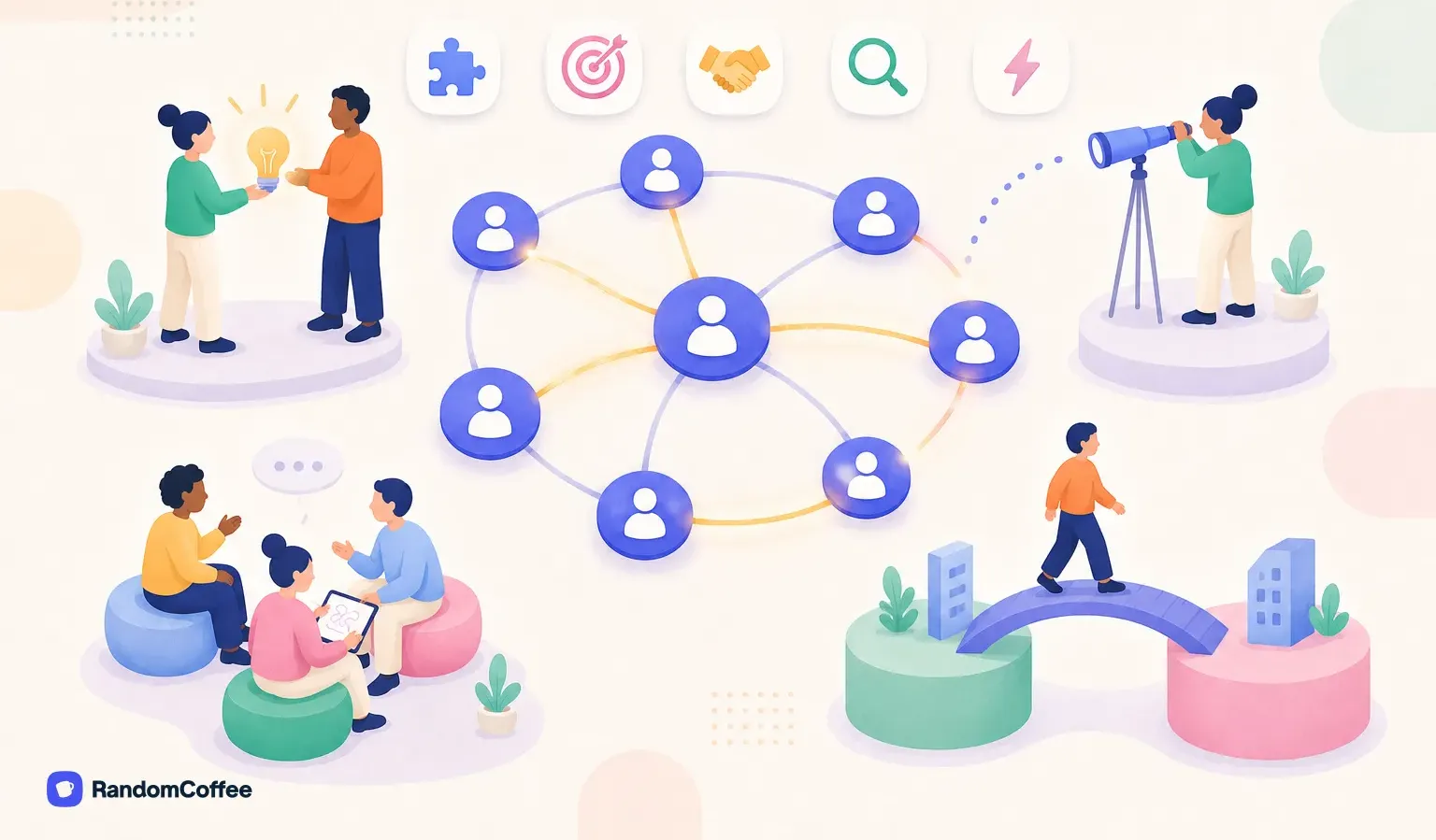
Amy Edmondson's research (Harvard Business School) on cross-boundary leadership shows that organizational breakthroughs almost always happen at the intersections between different disciplines, teams and perspectives. It is cross-silo connections that produce innovation, complex problem-solving and the ability to adapt.
The concept of weak ties, developed by sociologist Mark Granovetter, explains why. Strong ties (your team, your close colleagues) share the same information you have. Weak ties, those occasional connections with people from other circles, bring you new information: fresh perspectives, unfamiliar resources, opportunities that are invisible from inside your silo.
At work, this means a data analyst who talks regularly with a product designer will see problems that neither would have spotted alone. A salesperson who personally knows someone in operations can unblock a customer issue in one conversation instead of a five-email chain.
5 concrete actions to connect the right people
1. Map existing connections
Before adding more collaboration, understand the current relational structure. Who talks to whom? Which departments are disconnected? Which employees act as "bridges" between teams? Organizational network analysis (ONA) tools, or simply the participation data from a program like RandomCoffee, make these dynamics visible.
2. Make cross-silo encounters easy
The most effective way to create strategic weak ties is to spark them deliberately. A structured micro-connection program regularly connects employees who would never have interacted naturally: an engineer with someone from marketing, a new hire with a senior colleague from another department.
The key is regularity. A one-off meeting creates an anecdote. Weekly meetings create a network.
3. Build collaboration around complementarity, not the org chart
When you put together a project group or a committee, ask yourself: "Which perspectives do I need?" rather than "Which departments need to be represented?". The first question leads to smaller, more effective groups. The second leads to 15-person meetings where nobody dares to speak.
4. Protect time for deep work
Paradoxically, collaborating better sometimes means collaborating less. The highest-performing organizations set up protected time slots (Focus Time, No Meeting Days) so that everyone can turn the insights gathered in their interactions into concrete work. Collaborating with the right people is pointless if you never have time to act on it.
5. Measure quality, not quantity
Stop counting meetings, emails and Slack interactions. Measure these instead:
- The number of cross-team connections per employee
- The diversity of the internal network (how many different departments)
- The participation rate in connection programs
- The perceived impact: "This conversation gave me an idea, a contact or a solution"
The role of RandomCoffee in strategic collaboration
RandomCoffee does not create "more collaboration". It creates the right connections: the ones that cross organizational boundaries and bring complementary people together. Every match is an opportunity for a strategic weak tie: a 20-minute conversation that can unblock a project, spark an idea or simply remind everyone that they belong to something bigger than their own team.
Key takeaways
Performance does not come from collaboration in itself. It comes from the ability to connect the right people, at the right time, beyond natural silos. Organizations that grasp this distinction invest less in meetings and more in the quality of their relational fabric.
The result: more innovative teams, problems solved faster, talent that stays longer, and a culture where collaboration is a lever rather than a burden.
See how RandomCoffee connects your teams with the right people →
Frequently asked questions
What is the difference between strong ties and weak ties at work?
Strong ties are your close relationships: your direct team, the people you work with every day. They bring support and trust. Weak ties are your occasional connections with people from other circles. They bring new information, different perspectives and opportunities. Both are necessary, but organizations massively underinvest in weak ties.
How many cross-team connections does it take to see an impact?
BetterUp's research shows that from 5 connections outside one's direct team, the sense of belonging rises by 45% and the likelihood of staying with the company increases significantly. It is an achievable threshold: one connection a week for 5 weeks.
How can you avoid collaboration overload?
The principle is simple: favor the diversity of connections over their frequency. A 20-minute conversation each week with someone from another department is worth more than 5 extra meetings with your own team. And protect time for deep work, so that collaboration fuels output rather than the other way around.