

When a team starts outperforming everyone else, the instinct is to look for what makes its people different: better hires, a stronger leader, a smarter strategy. Ron Friedman's research into what he calls "superteams," published in Harvard Business Review, points somewhere else entirely. The teams that pull ahead during periods of rapid change are not the ones that started with the best plan or the most talented roster. They are the ones that learn the fastest.
That distinction matters more than it sounds. It means the gap between a great team and an average one is not fixed at hiring. It is built, continuously, through habits that most organizations never deliberately design for.
Talent and Planning Are Not What Separate Top Teams
Friedman's research is built on a simple but uncomfortable premise: initial conditions predict much less than most leaders assume. His case study of the Oklahoma City Thunder's turnaround, from a 58-loss season to championship contention, is instructive precisely because the roster did not change overnight. What changed was how fast the organization adapted, absorbed feedback, and improved.
The Real Differentiator: Learning Velocity
Learning velocity is not the same thing as collaboration, and conflating the two is where a lot of team-building efforts go wrong. A team can collaborate constantly, sit in the same meetings, share the same Slack channel, and still learn slowly if that collaboration never surfaces what is not working. Superteams build in mechanisms specifically designed to accelerate feedback and course-correction, not just interaction volume.
Three Habits of Teams That Keep Getting Better
1. They manage time, energy, and attention deliberately
High-performing teams treat focus as a finite resource to be protected, not an assumption. They build in recovery time and protect deep work instead of filling every hour with meetings, which is one reason lightweight, well-timed check-ins tend to outperform long status meetings for actually surfacing problems.
2. They actively make each other better, not just work alongside each other
This is the sharpest distinction between a group of skilled individuals and a genuine superteam. Members treat each other's growth as part of the job, not a side project. That habit does not stay contained inside a single team, it depends on connection across team boundaries, because the fastest-learning teams are pulling in outside perspectives, not just refining what they already know internally.
3. They are never satisfied with "good work," only with getting better
Teams that plateau tend to stop asking hard questions once output looks acceptable. Superteams build a continuous feedback loop into their normal rhythm instead of waiting for a quarterly review to surface what is not working.
Why Cross-Team Connection Accelerates Learning
Here is the part most performance frameworks miss: learning velocity is rarely something a team builds in isolation. Mark Granovetter's research on "the strength of weak ties" found that people outside your immediate circle are disproportionately likely to bring you genuinely new information, precisely because they are not exposed to the same inputs you already have. Teams that only talk to themselves tend to converge on the same blind spots faster than they solve them.
This is why informal moments between teams are not just a nice-to-have for morale. They are a direct input into how fast a team learns, because every conversation with someone outside your usual circle is a chance to import a solution, a shortcut, or a warning that your own team has not discovered yet.
How to Build Learning Velocity Into Your Team's Rhythm
Structure cross-team connection deliberately, do not leave it to chance
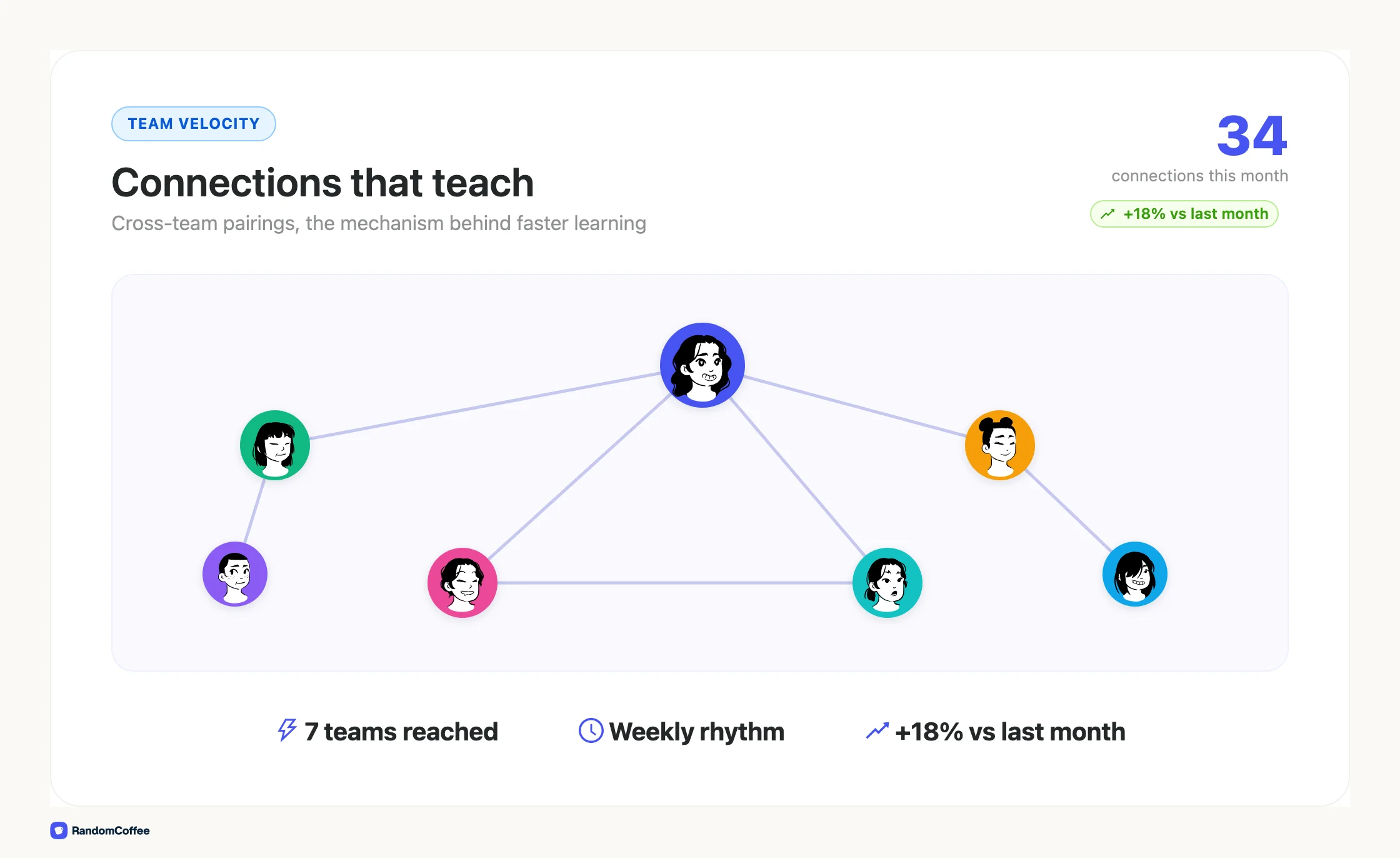
Weak ties do not build themselves at scale. Randomized, recurring pairings across departments give every team a steady stream of outside perspective instead of relying on people happening to bump into each other.
Pair new team members with a peer immediately
Onboarding buddies compress the time it takes a new hire to become a source of learning velocity themselves, instead of a pure consumer of it for months.
Use internal mobility as a deliberate learning channel
Employees who move between teams, even temporarily, carry knowledge with them. Structured internal mobility and mentoring programs turn that movement into a repeatable mechanism rather than a lucky accident.
Measuring Learning Velocity, Not Just Collaboration
Meeting frequency and Slack message volume measure activity, not learning. Track these instead:
- Time from identifying a problem to implementing a fix
- Diversity of people a team is regularly connecting with outside itself
- How often ideas from outside the team show up in the team's own work
- Retention among your highest performers, who tend to leave first when learning stalls
The best teams are not the ones with the best starting roster. They are the ones that turned learning into a habit instead of an event, and that habit depends on connection reaching well beyond the team's own four walls.
👉 See how RandomCoffee builds the cross-team connection that accelerates learning velocity.