Absenteeism and disengagement: how micro-connections rebuild workplace bonds


Absenteeism in France reached 4.5% in 2025, a record level matching 2022. Long-term sick leave rose 7.5% in a single year. Mental health conditions now account for 25% of long-term absences (Malakoff Humanis). Behind these figures lies a consistent signal: social bonds at work are fraying, and absenteeism is the most visible symptom.
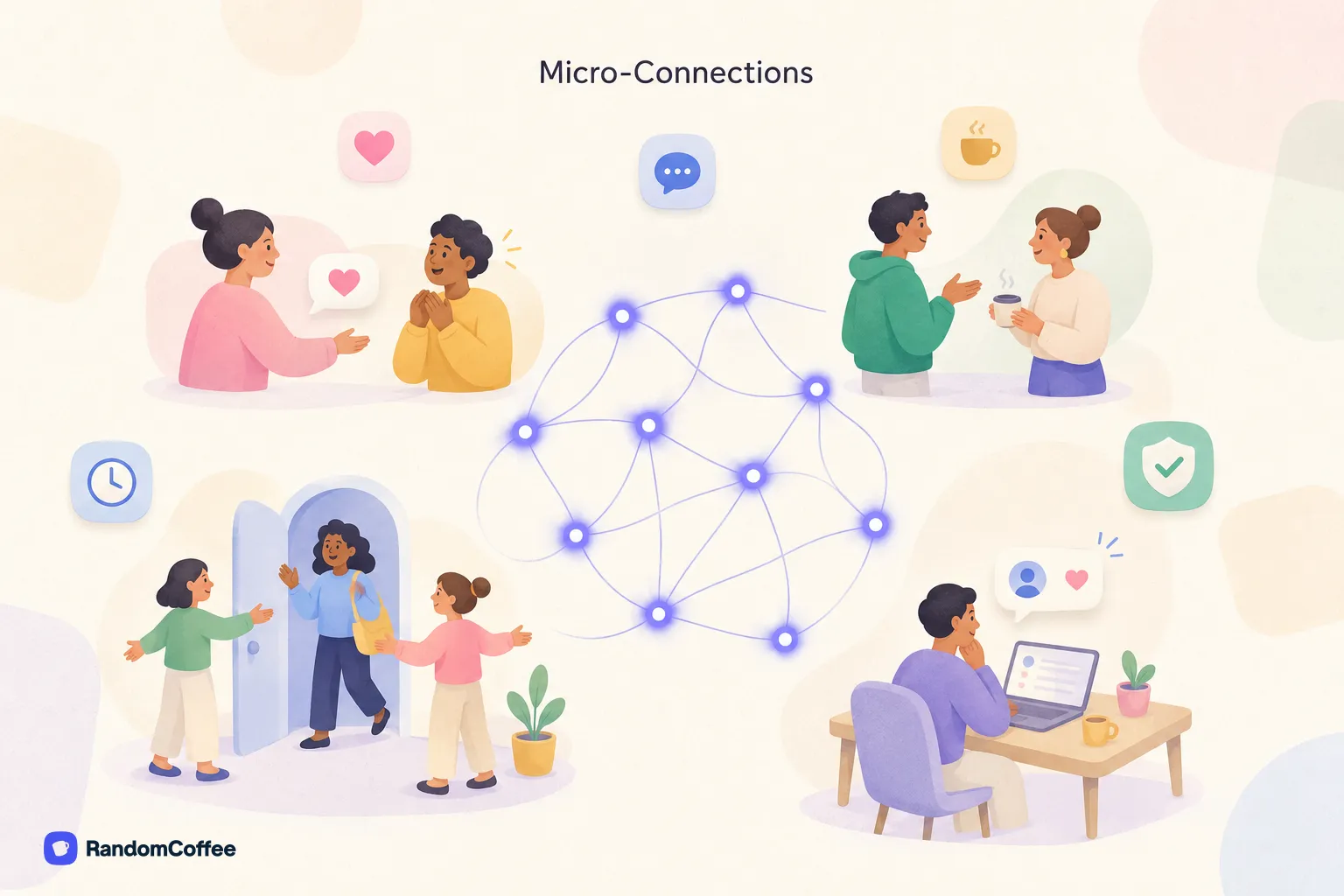
Yet most action plans focus on managing absences, not preventing them. Micro-connections, the brief but regular interactions between colleagues (checking in on someone, saying congratulations, spending 15 minutes over a coffee), offer a prevention lever that HR teams largely underuse.
Absenteeism in France: a shifting phenomenon
A change in profile, not in volume
The problem is not getting worse across the board. Short absences are falling: the share of employees off sick at least once a year dropped from 43% to 34%, and absences of 4 to 7 days have almost halved (WTW 2024 data). What is rising is absences of 3 months or more, which make up 61% of total absenteeism and affect 5.3% of employees, up 31% over five years (Ayming).
This shift toward long-term absence points to a deeper problem: the numbers are no longer driven by the flu, but by exhaustion, a loss of meaning and professional isolation.
Presenteeism, the blind spot
57% of employees who were not absent say they have worked while sick. So-called "hidden" absenteeism (employees who are physically present but disengaged) affects around 32% of the workforce, according to the Fondation Jean-Jaurès, a French think tank. By comparison, absences without a genuine reason account for only 2%.
Focusing on managing sick leave therefore means dealing with the tip of the iceberg. Employees who stay without really being there cost more in productivity than those who are absent.
The missing link: disengagement, isolation, absence
The correlation between engagement and absenteeism is one of the most robust in HR research. According to Gallup's meta-analysis, teams in the top quartile for engagement show 78% less absenteeism than those in the bottom quartile. Global engagement, meanwhile, fell to 20% in 2025, its lowest level since 2020, at an estimated cost of $10 trillion in lost productivity.
But engagement does not collapse overnight. It wears away little by little: a distant manager, colleagues you no longer run into, purely functional meetings with no room for personal conversation. Disengagement is often the result of gradual social disconnection.
Loneliness as a risk factor
A 2026 HBR study of 1,545 knowledge workers shows that 52% feel moderately or highly lonely at work. The most isolated report 27% lower satisfaction and 90% higher intent to leave. Another telling finding: the companies where employees feel loneliest organize 38% fewer social activities than the others.
"It is connection with other people, not with AI companions, that remains the most decisive factor in building a satisfied and engaged workforce."
Hadley and Wright, Harvard Business Review 2026
Micro-connections: an underrated prevention lever
What micro-connections are (and are not)
Micro-connections are not annual team-building days, cohesion off-sites or after-work drinks. They are the brief but repeated relational interactions that keep the social fabric intact day to day:
- Checking in on a colleague after a busy stretch
- A 30-minute virtual coffee with someone from another team
- A thank-you message after someone lends a hand
- An informal check-in when a colleague returns after an absence
Their strength lies in regularity and simplicity. A quarterly team-building event does not make up for 90 days without a single personal conversation.
Why they work
Micro-connections act on three levers at once:
The key role of the return to work
An employee coming back after several weeks of sick leave often lands in a relational vacuum: projects have moved on, team rituals have changed, conversations have happened without them. Without a structured micro-connection, the return is a fragile moment that can trigger a relapse.
"This connection is essential to keep the absence from dragging on."
Anaïs Georgelin, founder of SomanyWays
In practice, three simple steps are enough:
- During the absence: check in without talking about work. A simple, human, regular message.
- On return: a structured return-to-work conversation with the manager, followed by an informal coffee with two or three close colleagues.
- In the following weeks: a match with a "return buddy" to ease social reintegration.
How to build micro-connections into your HR strategy
1. Structure without making it rigid
The paradox of micro-connections is that they need to be organized and still feel natural. The answer: create the framework, not the content.
- Schedule biweekly virtual coffees through an automated matching tool.
- Offer optional ice-breakers, not mandatory agendas.
- Let participants choose their own pace (opt-in, with the option to pause).
2. Involve managers as relays
According to HBR, only 33% of employees have received guidance from their management on the importance of human interaction. Train managers to:
- Open team meetings with a quick non-work round (2 minutes).
- Schedule an informal monthly one-on-one check-in with each team member.
- Flag to HR the signs of an employee withdrawing socially.
3. Measure the impact on absenteeism
The link between micro-connections and absenteeism is measured in quarters, not weeks. Here are the indicators to cross-reference:
OLX Group took this continuous measurement approach: pulse surveys every two months, feedback workshops, manager upskilling. The result: +11% engagement, +15 points of trust in leadership and +5% survey participation.
4. Target at-risk groups
Absenteeism does not hit everyone equally. Some groups are more vulnerable to isolation:
- New hires: the first six months are critical. A structured connection program during onboarding reduces the risk of early departure.
- Full-time remote workers: without planned informal interactions, their bond with the organization gradually weakens.
- Multi-site teams: employees at secondary sites often feel left out of what happens at headquarters.
- Employees returning from long-term leave: the most critical moment for preventing a relapse.
RandomCoffee lets you create segmented matching programs for each of these groups, with connection criteria tailored to them (tenure, location, department, participation history).
From management to prevention: a change of paradigm
Most organizations manage absenteeism after the fact: employer-requested medical checks, corrective conversations, HR dashboards. These tools are necessary, but they come in too late. By the time an employee goes on leave for exhaustion, the disengagement has been building for months.
Micro-connections work upstream. They do not cure absenteeism; they keep the ground for disengagement from forming. Every virtual coffee, every thank-you message, every informal check-in is a micro-dose of social connection that sustains the sense of belonging.
Perhaps the most telling figure is this one: 32% presenteeism, against 2% of absences without a genuine reason. The real cost is not in sick leave; it lies in the employees who are present but have quietly checked out.
Where to start
Setting up a micro-connection program requires neither a large budget nor a major reorganization. Three concrete actions are enough to get started:
- This week: launch a virtual coffee pilot with 30 volunteers from three different departments. Every two weeks, 30 minutes, open format.
- This month: train your managers on return-to-work conversations after an absence and on the informal monthly check-in.
- This quarter: add a connection score to your pulse surveys and cross-reference it with your absenteeism data by department.
Absenteeism is a complex phenomenon. But the simplest answer remains the most underrated: keep the human connection alive, one micro-connection at a time. RandomCoffee helps you structure these connections across your entire organization.