HR guide: how to build a virtual coffee program that truly engages your teams


One in five employees worldwide feels lonely at work. This figure, from Gallup's 2024 State of the Global Workplace report, climbs even higher in organizations where remote work is the norm. In France, 45% of employees say they feel isolated at least some of the time (KPMG 2025).
The paradox is striking: there have never been so many communication tools, yet human connection keeps thinning out. Virtual coffees, those informal 30-minute meetings between colleagues who do not work together day to day, offer a simple and measurable answer to this problem. This guide explains, step by step, how to set them up, structure them and run them so they become a real driver of engagement.
Why virtual coffees have become essential
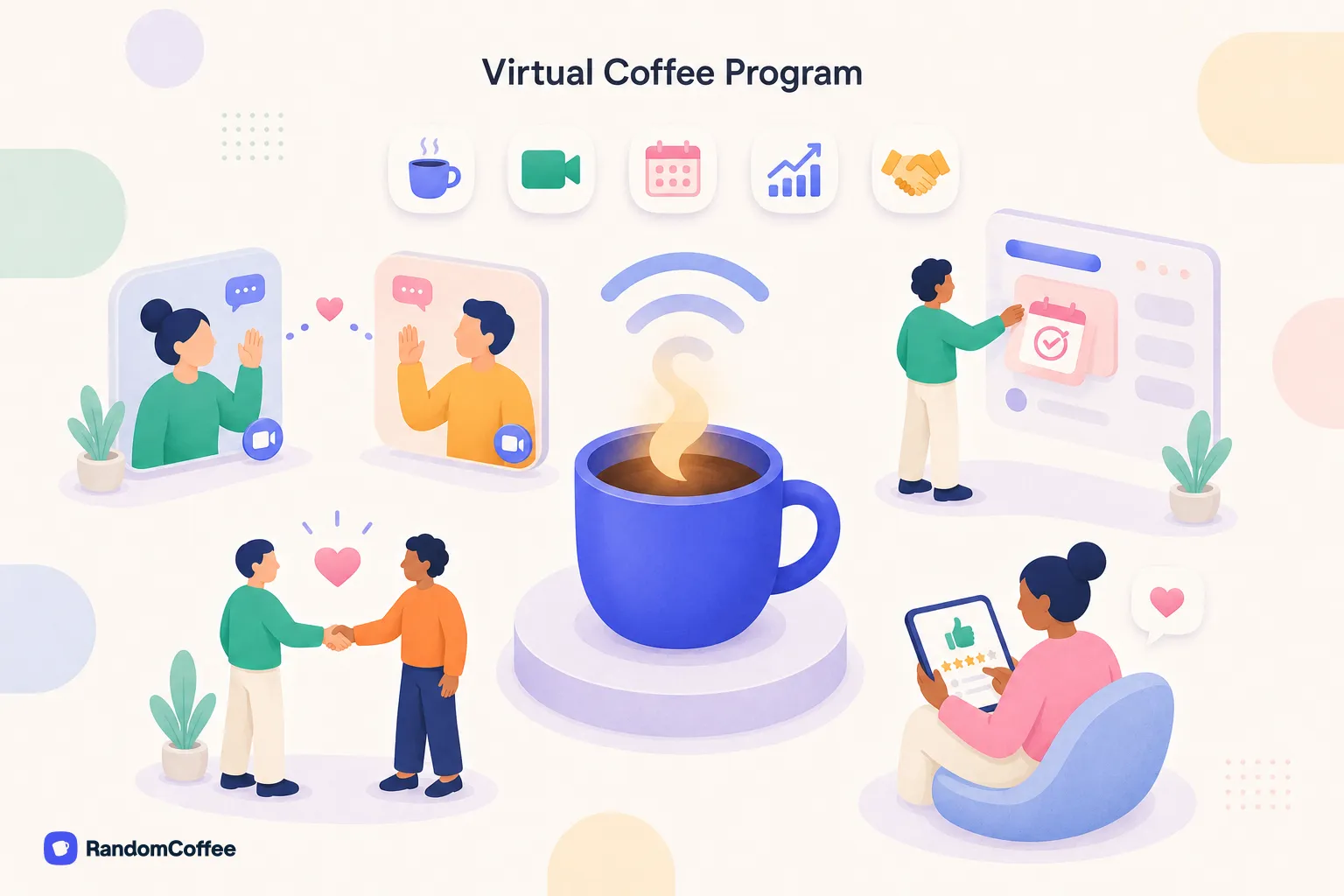
1. Social connection cannot be decreed, it has to be structured
In a hybrid environment, spontaneous hallway encounters disappear. Teams that work well in the office build up relational capital that wears away as soon as remote work sets in. According to a 2026 HBR study of 1,545 knowledge workers, 52% say they feel moderately or highly lonely, including those who interact often with their colleagues.
Isolation is therefore not just a question of how often people are in contact. It is a question of relationship quality. Virtual coffees address this by creating a space with no work stakes, where conversation flows freely.
2. Technology does not replace human connection
Conversational AI, well-being chatbots and virtual assistants are multiplying. Yet the same HBR study reveals that only 12% of regular AI users feel these tools help them feel less lonely. The conclusion is clear: it is connection with other people, not with machines, that builds satisfaction and loyalty.
Virtual coffees are the antidote: a human format that is simple, repeatable and requires no expensive infrastructure.
3. A measurable driver of engagement
Buffer, a fully remote company of 70 employees, has run a biweekly virtual coffee program for several years. The result: more than 6,000 introductions made, 455 completed conversations in 2025, and a 100% approval rate in post-conversation surveys. That is more than three times the average for companies of a similar size.
"Our biweekly intros let us connect as humans beyond work."
Jenna Meindertsma, Buffer
How to structure your program in 5 steps
1. Set a clear objective
A virtual coffee program without a defined objective turns into a vague ritual that nobody prioritizes. Before launching anything, answer this question: what problem are you solving?
- Onboarding new hires: speed up how quickly they absorb the culture. Ontra, for example, achieves an eNPS of 95 in the first week and 88 at 45 days, with 99% of new hires feeling welcomed.
- Breaking down silos: tackle the silos between departments by building bridges between people who never cross paths.
- Retention: reduce the feeling of isolation, a direct driver of intent to leave (+90% among the loneliest employees, according to HBR).
Choose one main objective. Secondary benefits will follow naturally, but the program will be easier to steer with a precise target.
2. Design the right format
The format that works best, based on feedback from companies like Buffer, is simple:
- Length: 30 minutes, no more. Long enough for a real conversation, short enough not to feel like a chore.
- Frequency: every two weeks. Enough to build a habit without overloading calendars.
- Format: open conversation. No agenda, no meeting notes. The goal is human connection, not productivity.
- Participation: opt-in, with the option to pause. Voluntary participation is essential to keep conversations meaningful.
"When you've recently talked to someone, it's much easier to follow up later and share a thought."
Carolyn Kopprasch, Buffer
3. Choose a smart matching logic
Purely random matching can work in a small organization. Beyond 50 people, it quickly produces pairings that are not very relevant. Smart matching takes into account:
RandomCoffee lets you configure these matching criteria directly in the platform: cross-department rotation, time zones, segmentation by tenure or by site. The result: more relevant conversations and a participation rate that stays higher over time.
4. Involve managers from the start
A virtual coffee program run by HR alone risks being seen as a side initiative. Getting managers involved changes the game:
- Lead by example: when a manager takes part, it normalizes the practice for the whole team.
- Free up time: a simple message ("take 30 minutes for your virtual coffee this week") is enough to remove the hesitation.
- Share the results: passing on positive feedback in team meetings strengthens the program's legitimacy.
According to HBR, only 33% of employees say they have received guidance from their management on the importance of human interaction. Managers who actively support virtual coffees fill that gap.
5. Measure the impact with the right indicators
What is not measured does not last. Here are the indicators to track:
Culture Amp recommends combining an annual engagement survey with pulse surveys every one to three months. Virtual coffees become a measurable lever when you correlate program participation with your internal survey scores.
The 4 mistakes that kill a virtual coffee program
1. Launching without explaining the "why"
If employees do not understand the objective, they see the program as yet another HR initiative disconnected from their reality. Explain it clearly: "We found that 45% of you feel isolated. This program is our concrete response."
2. Making participation mandatory
Obligation kills authentic conversation. The opt-in format, with the option to pause, ensures that every conversation is chosen, not endured.
3. Neglecting the post-match experience
The match is only the beginning. Send conversation starters (ice-breakers), light reminders and a short satisfaction survey after each session. These small details make the difference between a thriving program and an abandoned one.
4. Not iterating on formats
After six months, the classic formula can run out of steam. Introduce variations to keep interest alive:
- Themed coffees: a suggested discussion topic (a book, a hobby, a work challenge).
- Groups of three or four: for employees who prefer group dynamics.
- Cross-department connection coffees: targeted at bringing two specific teams closer around a shared project.
- Informal mentoring circles: pairing senior and junior profiles.
The French case: balancing remote work and social connection
In France, 55% of remote work agreements cap remote work at two days a week. The stated goal is clear: preserve the collective bond. But limiting remote work is not enough to create connection. Being physically present in an open-plan office does not guarantee quality interactions.
Virtual coffees complement physical presence by structuring the encounters that the office alone no longer creates. They work just as well on remote days as on office days, because their strength lies in the matching, not in the channel.
For groups that are often left out of these initiatives (frontline workers, multi-site teams, part-time employees), a well-segmented virtual coffee program is sometimes the only cross-team connection tool available.
What virtual coffees really change
Virtual coffees are not a gimmick. They meet a fundamental need that hybrid work has made invisible: human connection. Companies that structure them properly see measurable gains in engagement, retention and cross-team cohesion.
The starting point is simple: pick 30 volunteers, set a biweekly cadence and measure what happens. If you want to go further, RandomCoffee automates smart matching, tracking and analysis of your connection programs at scale.