September onboarding wave: why your new grads and apprentices need a buddy before they need a manager


Every September the same scene plays out. Apprentices and interns arrive in waves during the first two weeks, the graduates hired in spring start their jobs, and colleagues returning from parental or long-term leave walk back into an office that has changed while they were away. All of it lands in the exact week when managers have the least time: new-quarter priorities, 2027 budgets to prepare, projects frozen since July to restart.
You know how it goes. A well-designed welcome kit, three days of presentations, and a person who, on the Thursday of their first week, still has not found anyone to ask a question they consider too basic for their manager. This article starts from that person. It proposes a way to onboard them that relies neither on managers' time nor on the team's goodwill: a buddy, picked automatically, who stays with them for 90 days.
September is the biggest arrival wave of the year, at the worst possible time
Search interest for "back to work" style queries jumps by a factor of eight in late August compared with the rest of the year, and for good reason. Apprenticeship contracts follow the academic calendar, graduate recruiting campaigns close before summer, and returns from leave cluster on the same few weeks. For many companies, September alone accounts for a third of the year's arrivals.
Read those numbers together. The people already in place are struggling to restart, the youngest find the office stressful before they even have habits there, and one hire in five is gone before the end of the quarter. The September problem is not an onboarding-schedule problem. It is a problem of people arriving at the precise moment nobody has bandwidth for them.
We described the disengagement of existing teams in why September matters more than January. This time we are looking at the other side of the season: the people who do not have a team yet.
What they want is not in the welcome kit
Ask newcomers what was missing from their onboarding and the answer is almost never "information". They had too much of it, not too little. What was missing is a person. In the 2025 TalentLMS and BambooHR survey, 31% of employees said their onboarding lacked human interaction. The 2026 Kahoot! survey of 4,000 office workers goes further: 56% want closer connections with colleagues, 39% feel lonely at work, and among Gen Z, one in two says they feel disconnected from their company.
Those figures cover the whole workforce. A 21-year-old apprentice landing in an 800-person company, on a site where their manager is present two days a week, stacks every risk factor at once: young, new, often hybrid without having chosen it. They do not need the org chart explained a third time. They need to know who they can say "I did not understand" to without it counting against them.
And that someone cannot be the manager. Not for lack of goodwill: Gallup measures in 2026 that only 22% of managers are engaged themselves, and that 45% of them feel daily stress, against 39% of individual contributors. Gartner finds that close to six employees in ten say they do not get the on-the-job coaching they need. Handing the human side of onboarding to the manager in September means asking the most from the person who has the least.
A buddy does what the manager cannot
Microsoft measured the effect of a buddy program on several thousand new hires, and the results, published in Harvard Business Review, remain the reference on the subject. What matters is not having a buddy. It is seeing them.
The buddy works for a simple reason: nothing is being evaluated. You can admit to a buddy that you have not understood the product, that you do not know how to book a room, or that Monday's meeting makes no sense to you. You do not say that to the person who will sign off your probation review. We have written before about why meeting new colleagues from day one matters. The buddy is the structured version of that idea.
Three conditions separate a buddy program that works from a line in the employee handbook:
- The buddy works in another team. That is what makes the relationship stakes-free, and what gives the newcomer a second door into the company.
- The pair exists on day 1, not in week 3. First impressions form fast. Enboarder estimates that 86% of new hires decide within the first six months how long they will stay, and much of that decision is made in the first weeks.
- Nobody has to remember to follow up. The program dies when it depends on buddies' memory. It lives when meetings are suggested, booked and reminded without anyone thinking about it.
In practice: a buddy for every September arrival, without a spreadsheet
The question we hear most is not "should we run a buddy program". It is "who is going to manage 40 pairs in September when the HR team is already drowning". The answer fits in one picture.
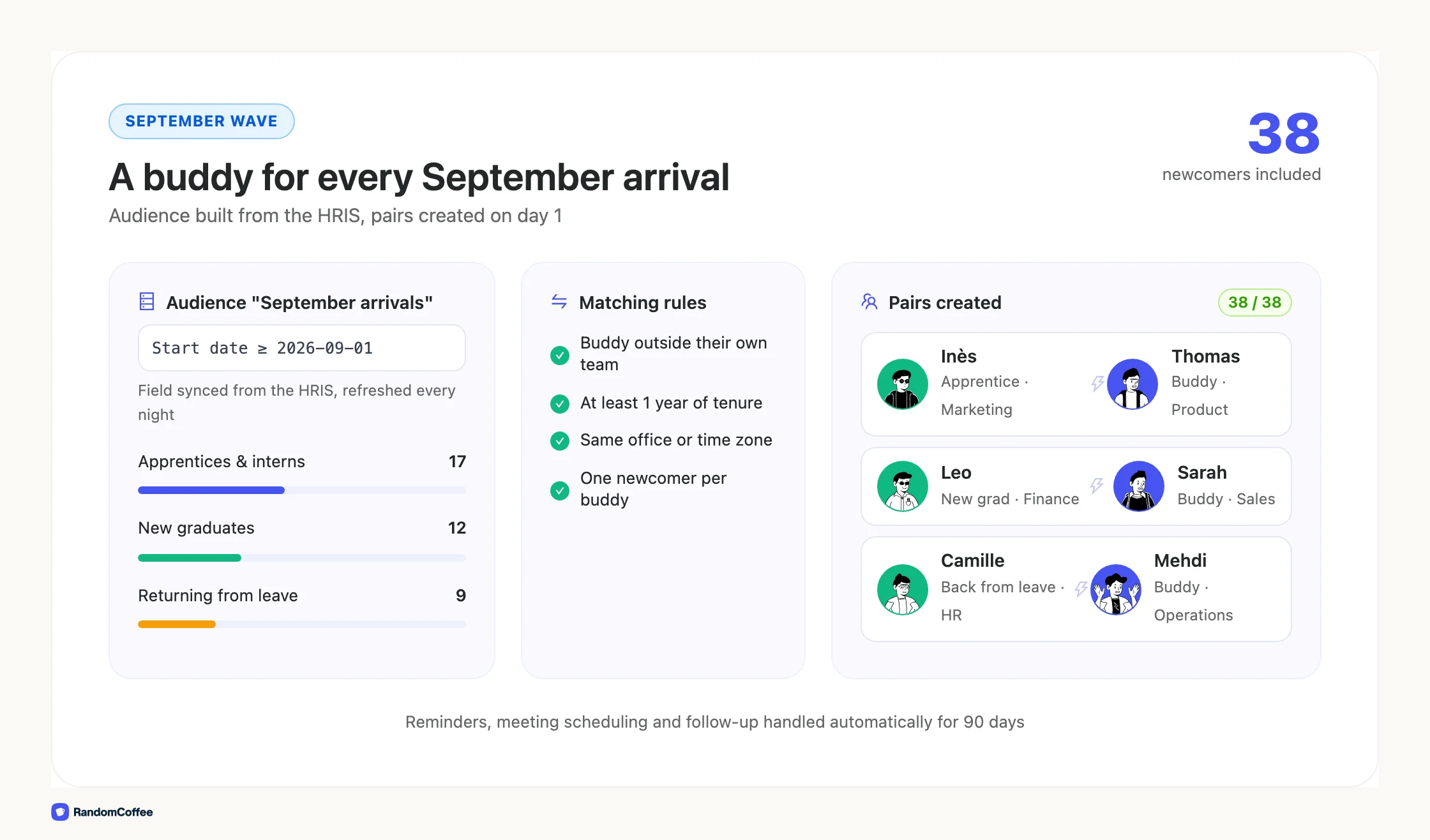
Here is what the platform does, step by step:
- The audience builds itself. HRIS synchronization pulls each person's start date, including from your custom fields (apprentice status, site, division). A rule such as "start date after September 1" is enough for every new arrival to join the program's audience that same night, with nobody adding them by hand.
- Buddies are picked by your rules. Outside the newcomer's team, at least one year of tenure, same office or time zone, one newcomer per buddy. Matching rules apply to everyone, and the engine looks for the best combination across the whole cohort, not just pair by pair.
- Pairs are created on day 1. The newcomer gets their introduction in Teams or Slack with a proposed slot for the first coffee. The buddy gets the same, plus one sentence on what is expected of them.
The full mechanism is described on our page dedicated to new hire onboarding. The point that matters for September is that there is no "program preparation": once the rules are set in August, the September waves handle themselves.
The 90 days seen from the apprentice's chair
A buddy program is judged by what the newcomer experiences, not by the number of pairs created. Here is the journey we recommend, and the one we see working in companies that welcome cohorts each September.
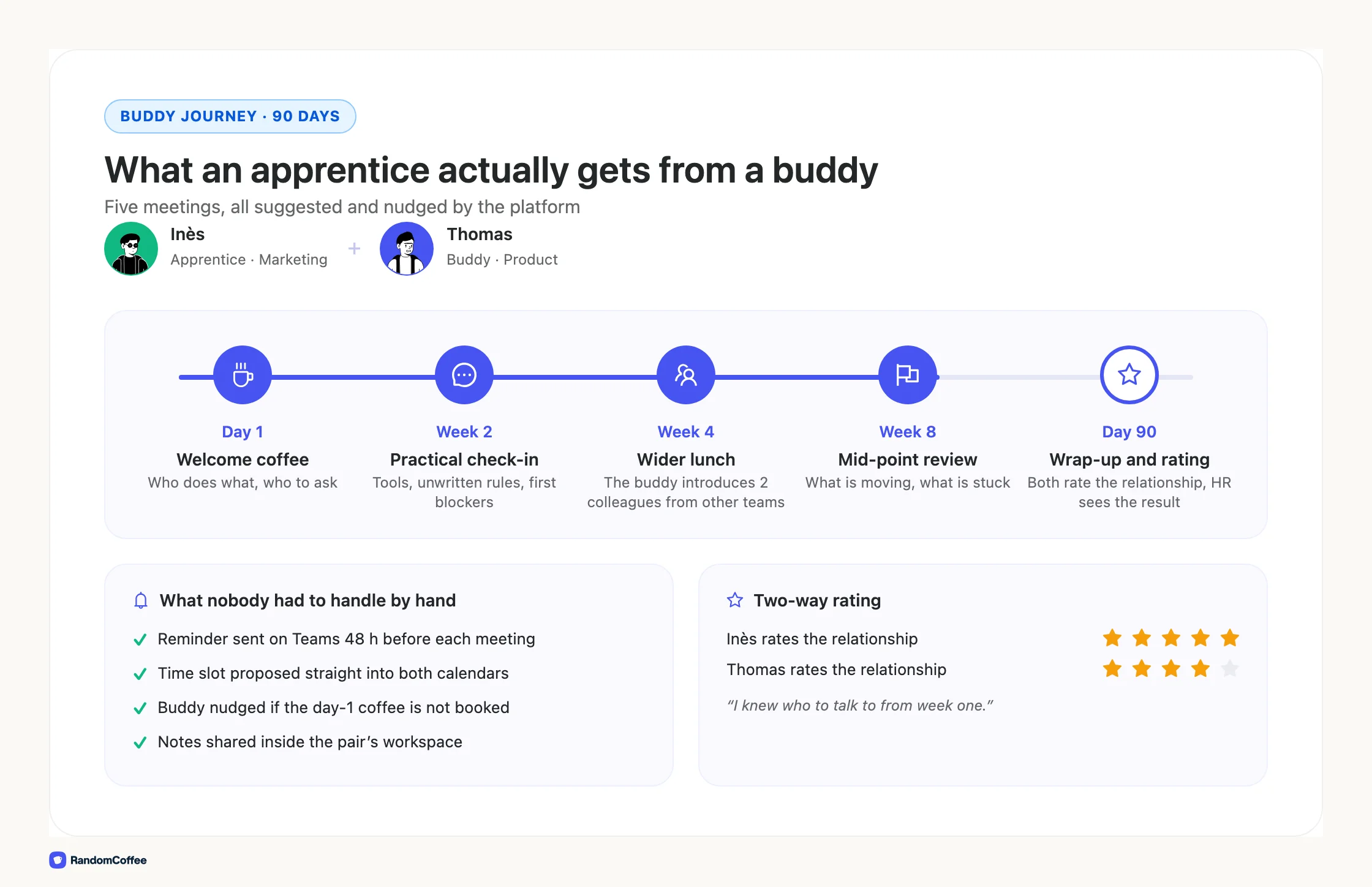
Three details make this journey sustainable for the buddy. The reminder arrives 48 hours before each meeting, in their messaging tool, not in an inbox they no longer read. The time slot is proposed straight into both calendars through the booking page. And if the day-1 coffee is not booked after three days, the platform does the nudging, not the HR team. This participation and reminder mechanism is what separates a program that reaches 90% active pairs from one that stalls at 40%.
The two-way rating deserves a word. Until recently, most tools had one person rate the pair. Since this summer, each participant leaves their own rating in our mentoring and buddy programs, and the dashboard ranks buddies by the feedback they receive. So by December you know who to ask again for the January wave, and who needs a lighter pairing next time.
Three mistakes we see every September
1. Picking the buddy from the newcomer's own team
It is the easy option: the colleague at the next desk, who "knows the job". Except that they are also the person the newcomer will have to work with, sometimes compete with, and will not admit to being lost. A same-team buddy quickly becomes a technical tutor. That is not useless, but it is not the role. The buddy is there for everything else: the codes, the people, the questions unrelated to the job. For job expertise, we recommend a separate knowledge transfer program, launched later.
2. Waiting until "everyone has arrived" to launch
Companies that wait until September 20 to create pairs, once the cohort is complete, miss the three weeks that matter most. A continuously running onboarding program does not have this problem: each person is paired on their start date, not on the wave's launch date. Our guide to new hire orientation programs explains why the first day weighs more than the first month.
3. Counting on buddies to remember
A volunteer buddy is full of goodwill on September 1. On the 22nd they have a late client deliverable and have not thought about their newcomer in ten days. That is not a character flaw, it is what happens to everyone. If your program relies on participants' memory, it fades around week four. If it relies on automatic reminders and a slot already proposed, it holds for the full 90 days.
And the people coming back
The September wave is not only new contracts. A return from six months of parental leave, a return from long sick leave, an internal move between two sites: these people know the company, but no longer quite know the team, the projects or the tools. They are often left out of onboarding because they "are already here". Yet they benefit from a buddy almost as much as an apprentice does, with a shorter cadence, four to six weeks, and a buddy chosen for what changed during their absence. We describe this case on our page about return from leave and re-onboarding.
The same mechanism serves well beyond onboarding. Regular micro-connections between colleagues who do not work together are one of the most reliable levers against isolation, as we explained in this article on belonging at work, and one of the simplest ways to take pressure off managers.
Where to start this week
If your apprentices and graduates have already arrived, it is not too late, provided you move fast. Three actions fit in a week:
- List arrivals since September 1 and those planned through the end of October, with their site and team. If your HRIS is connected, that list already exists.
- Open a call for volunteer buddies with a clear promise: five meetings over 90 days, nothing to prepare, nothing to schedule yourself.
- Create the pairs this week, with a first coffee within five days, even for people who arrived two weeks ago. A pair that starts in week 3 is still worth far more than no pair at all.
An apprentice who found someone to talk to in the first week will stay longer, learn faster and speak better of you to their classmates. A graduate who knows three people outside their team before the end of month one already has a reason to stay past probation. None of these outcomes asks more of your managers. They ask for a buddy, created on the right day, and a mechanism that holds on its own until day 90.
If you want to see what a September buddy program looks like configured for your company, with your rules and your HRIS data, book a demo. It usually takes less than a week between the first conversation and the first pairs created.